What You’ll Learn in This Article
-
- Highlights and exhibits at the CITY HUNTER Original Art Exhibition in Osaka
- What to know before visiting, including estimated visit time, photography rules, and tickets
- Yuki Hirako’s love for the series and the exhibits that impressed him most
We attended a media preview on the day before the opening of “CITY HUNTER Original Art Exhibition: FOREVER, CITY HUNTER!!,” which begins at Namba Parks Museum in Osaka on Saturday, July 11, 2026.
More than 400 original hand-drawn works are on display across seven chapters, tracing Ryo and Kaori’s story from their first meeting to the point when they recognize each other as irreplaceable partners. The exhibition is also packed with photo-worthy recreations, including the 100-ton hammer, the message board at Shinjuku Station’s East Exit, the underground shooting range, and Café Cat’s Eye.
This article takes a detailed look at the exhibition flow we experienced at the Osaka venue, photography precautions, how much time to allow, and the thoughts on CITY HUNTER that Alco & Peace member Yuki Hirako shared during an approximately 19-minute talk.
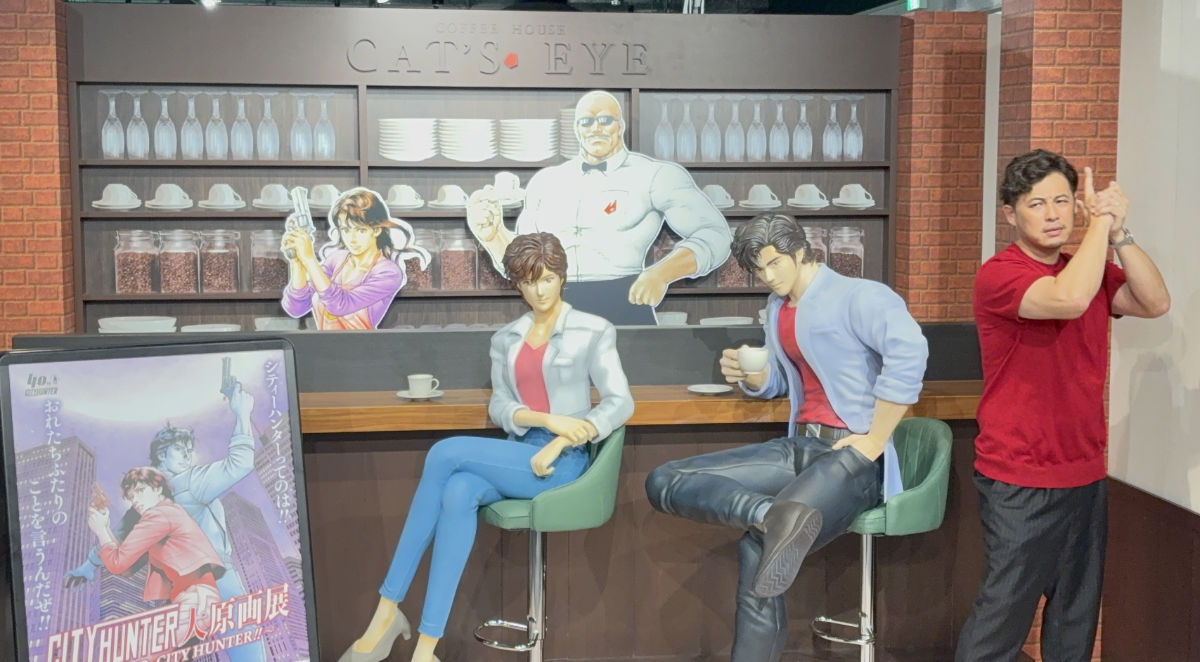
Yuki Hirako of Alco & Peace appeared at the preview held the day before opening. This photo was taken in front of the life-size Café Cat’s Eye display.
The exhibition runs from Saturday, July 11 through Sunday, August 23, 2026. It will be closed on Monday, August 17.
The venue is Namba Parks Museum on the seventh floor of Namba Parks. Doors open at 11:00 a.m., last admission is at 5:30 p.m., and the venue closes at 6:00 p.m.
CITY HUNTER Original Art Exhibition Official Website
Buy on ASOVIEW: CITY HUNTER Original Art Exhibition
Admission Ticket
Highlights We Discovered While Covering the CITY HUNTER Original Art Exhibition in Osaka
The Osaka venue is not simply an exhibition of framed original artwork.
Wall colors, enlarged graphics from the manga, the sound of rain, video, music, and life-size recreations work together to let visitors walk through and relive the story of CITY HUNTER.
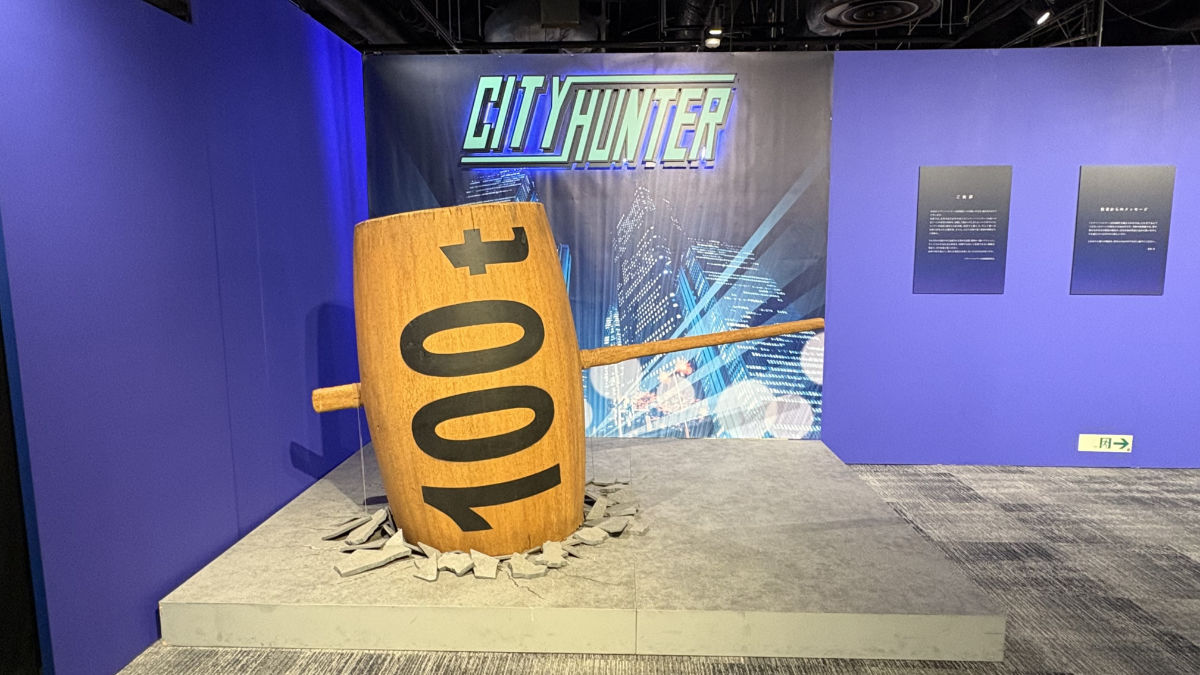
Kaori Makimura’s iconic 100-ton hammer greets visitors at the entrance.
The first thing you notice at the entrance is Kaori’s 100-ton hammer. Its size alone makes an impact, and this is likely to be a popular photo spot both before and after entering.
When it is crowded, it may be easier to keep moving instead of stopping at the entrance and return for photos after viewing the exhibition.
An Introduction Beginning with “XYZ” and Leading into the Night of Shinjuku
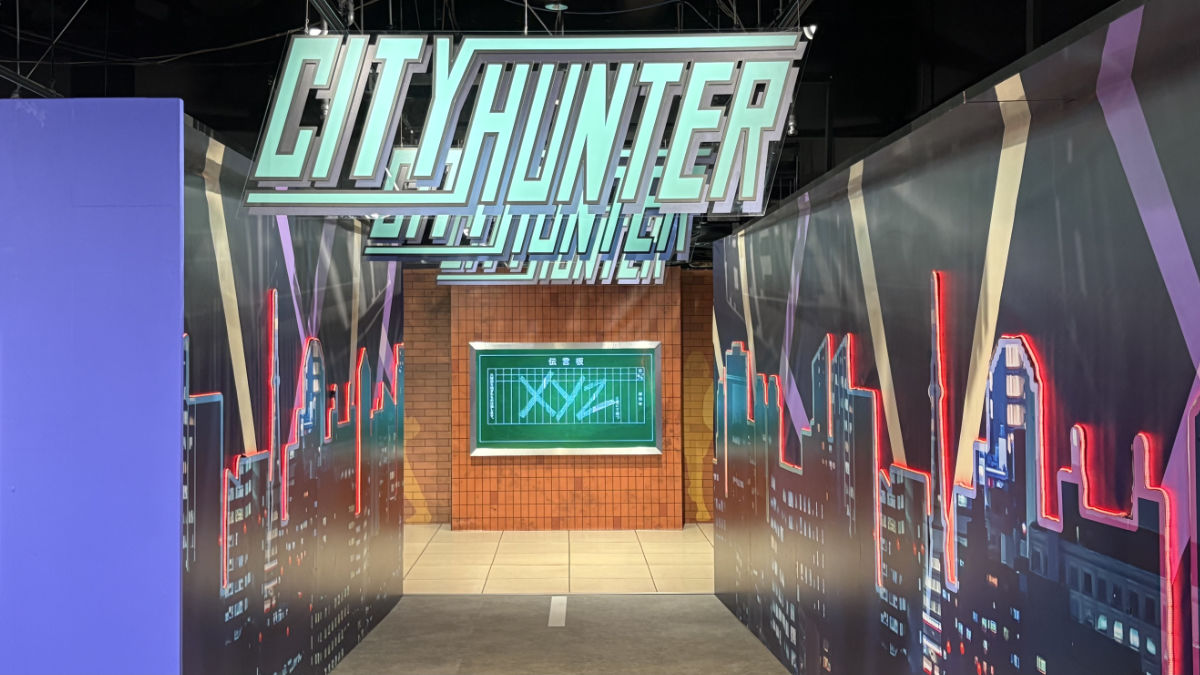
Beyond a corridor evoking Shinjuku at night is a message board symbolizing the beginning of a request.
As you proceed through the blue-and-purple corridor, a space resembling the message board at Shinjuku Station’s East Exit appears.
Writing “XYZ” on the message board is the signal that begins the story, delivering a last-resort request to CITY HUNTER.
You will want to start taking photos as soon as you enter, but there are many more photo spots ahead. Check your phone’s battery and available storage before your visit.
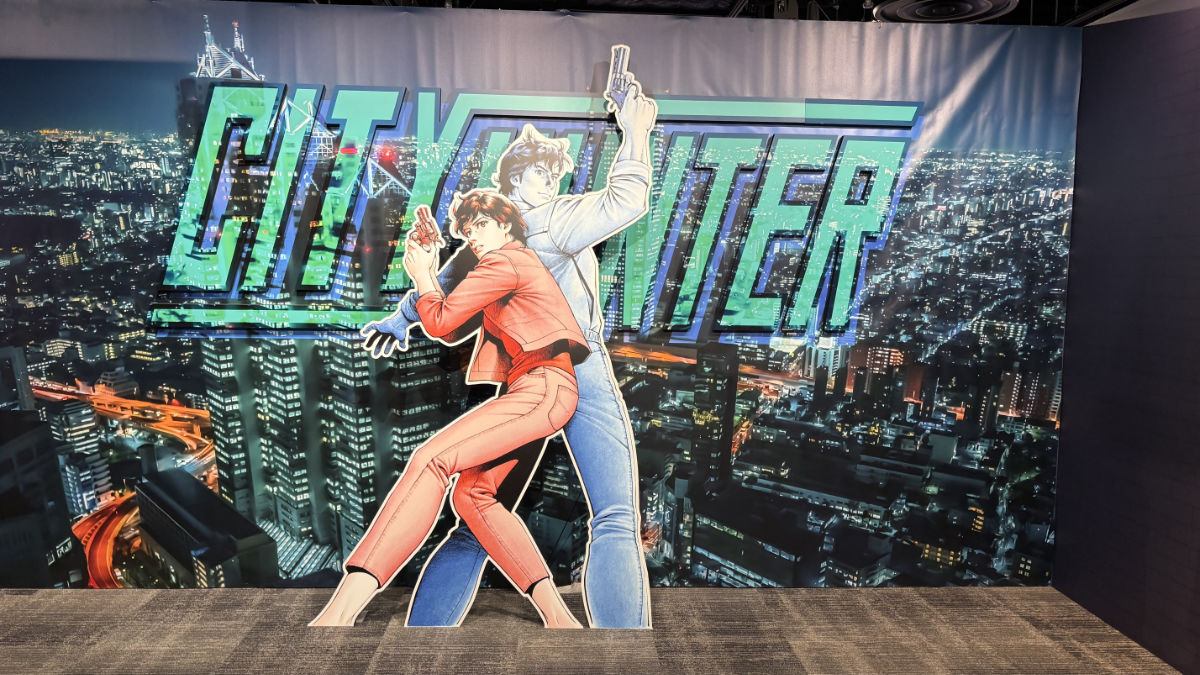
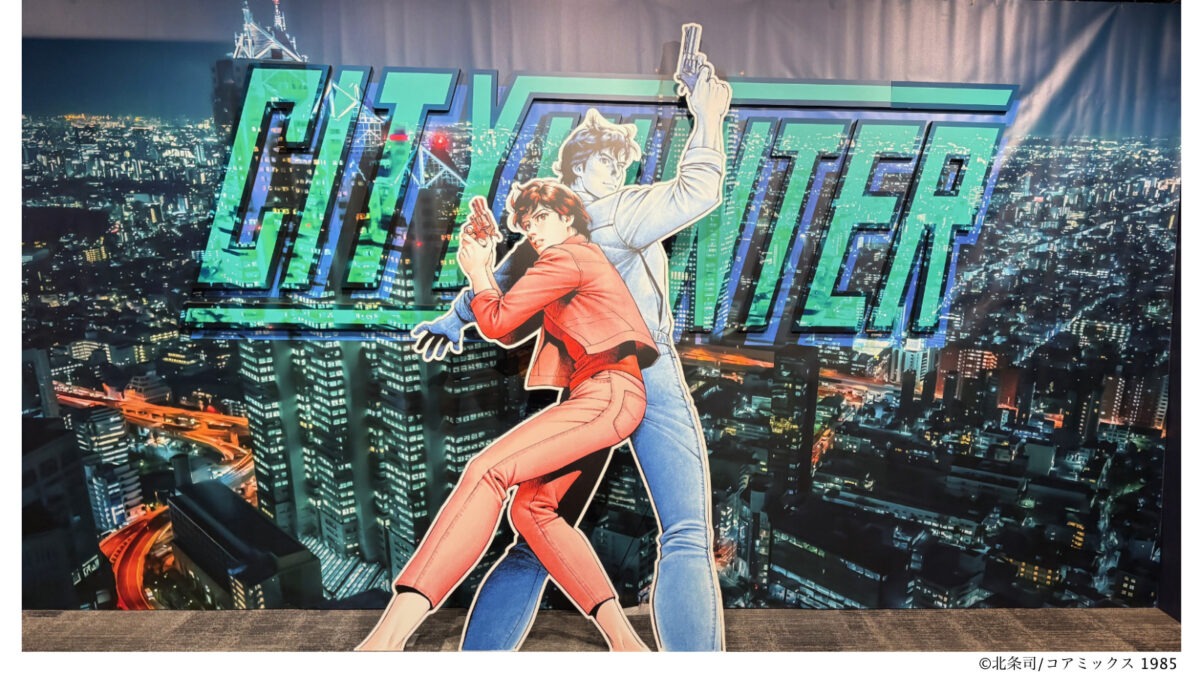
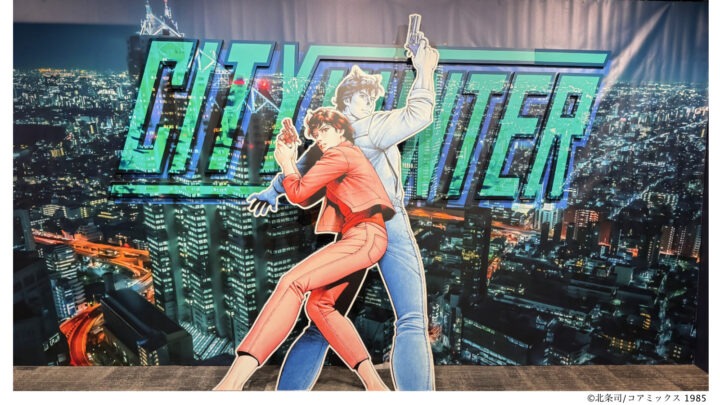
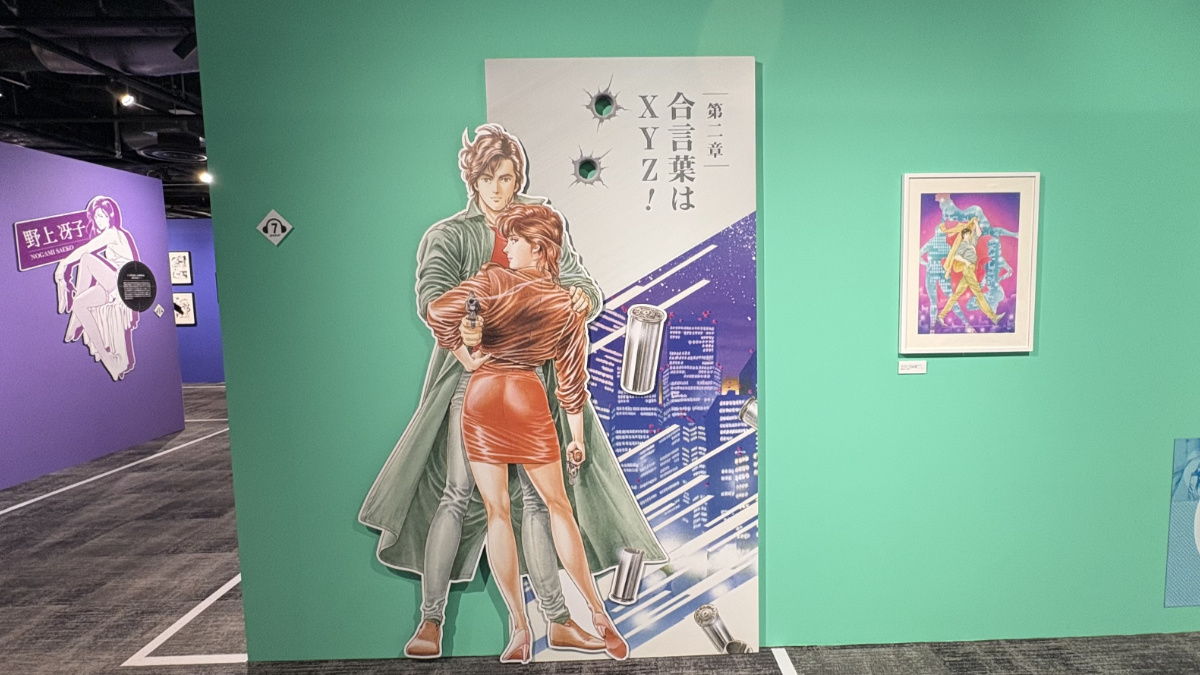
This large visual lets you step between Ryo and Kaori for a photo against the Shinjuku night skyline.
Experience More Than 400 Original Drawings Across Seven Chapters
The exhibition is organized into seven chapters.
It progresses from Ryo and Kaori’s fateful meeting and their story with Makimura to trust with friends and clients, comedic everyday life, hard-boiled battles, and finally the bond between Ryo and Kaori.
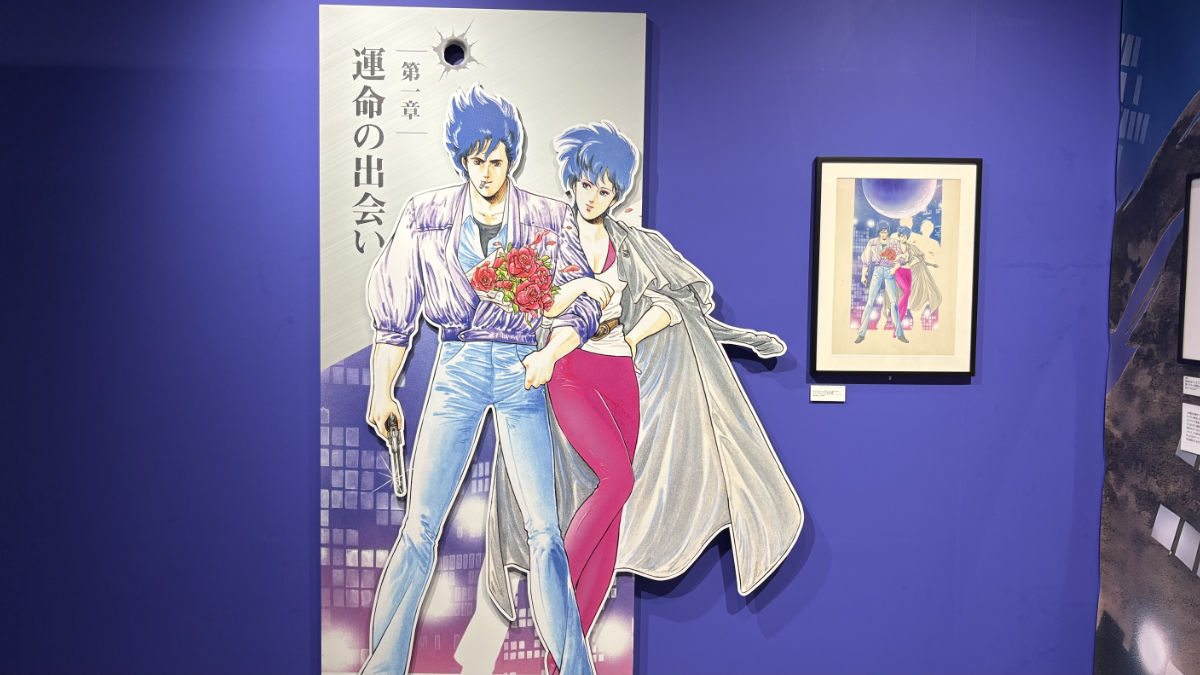
The story begins with the “Fateful Meeting” connecting Ryo, Kaori, and Hideyuki Makimura.
The first chapter looks back at why Ryo and Kaori began working together, including their relationship with Hideyuki Makimura.
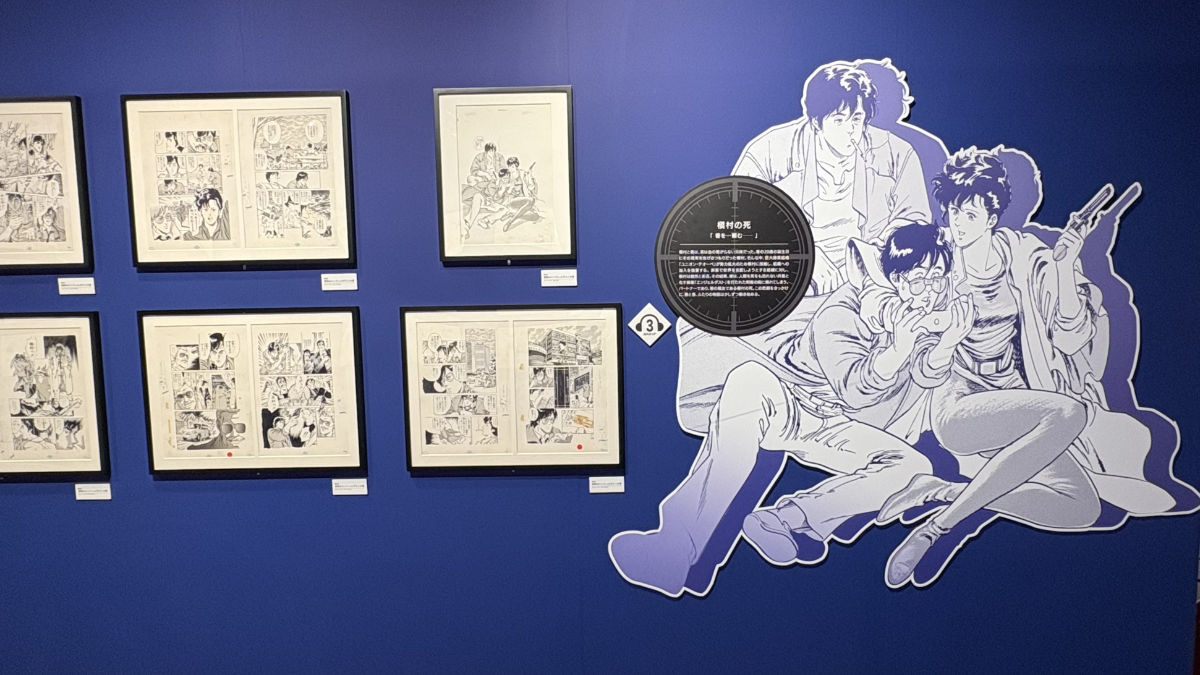
Each chapter combines original artwork with large visuals to convey the flow of the story.
Characters and lines representing each scene are displayed prominently beside the original pages, making the focus of each chapter easy to follow even for visitors who have not read the manga.
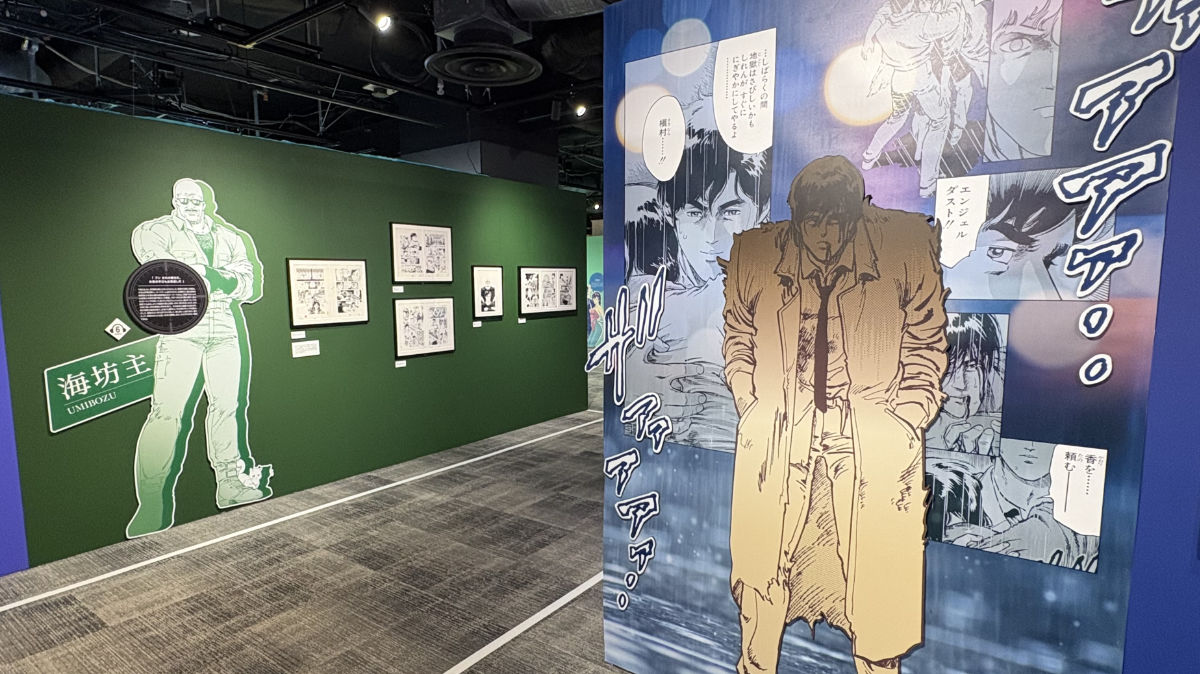
Changes in wall color and graphics make it visually clear when you have entered the next chapter.
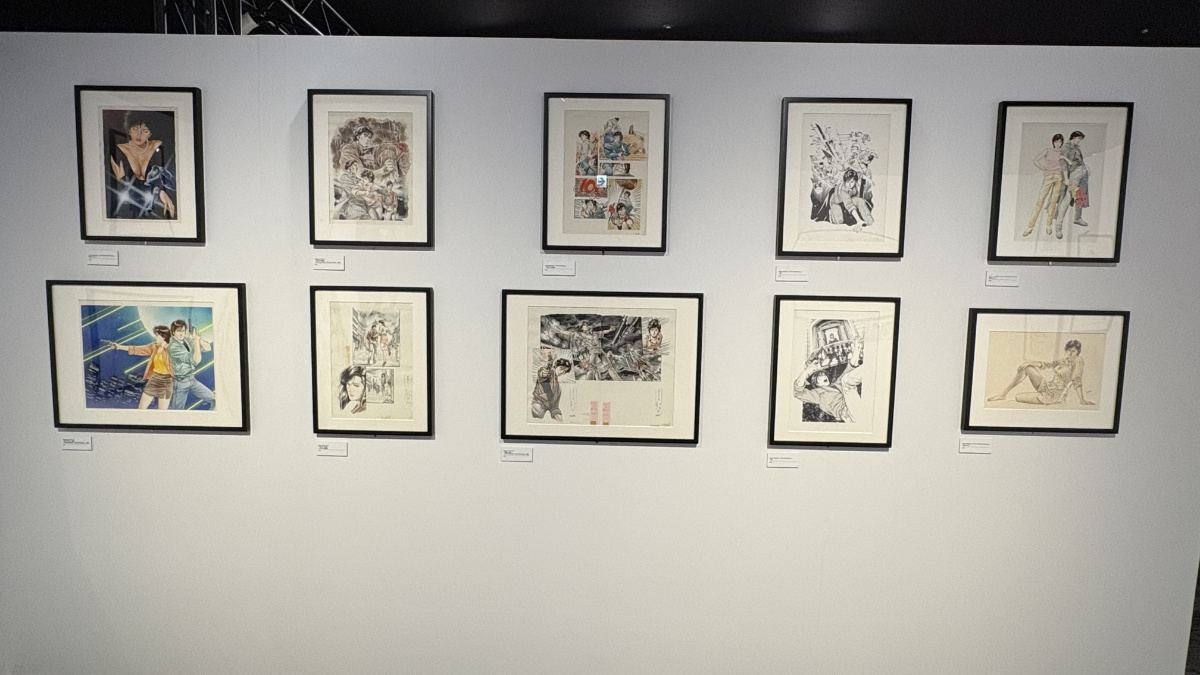
Viewing the manuscripts up close reveals details that are easy to miss in printed manga volumes.
You can see brush and pen strokes in solid black areas, pasted-in dialogue, traces of corrections, and delicate effects made by scraping screentone. The appeal of an original art exhibition is that it reveals not only the finished image but also the time and work involved in creating the manga.
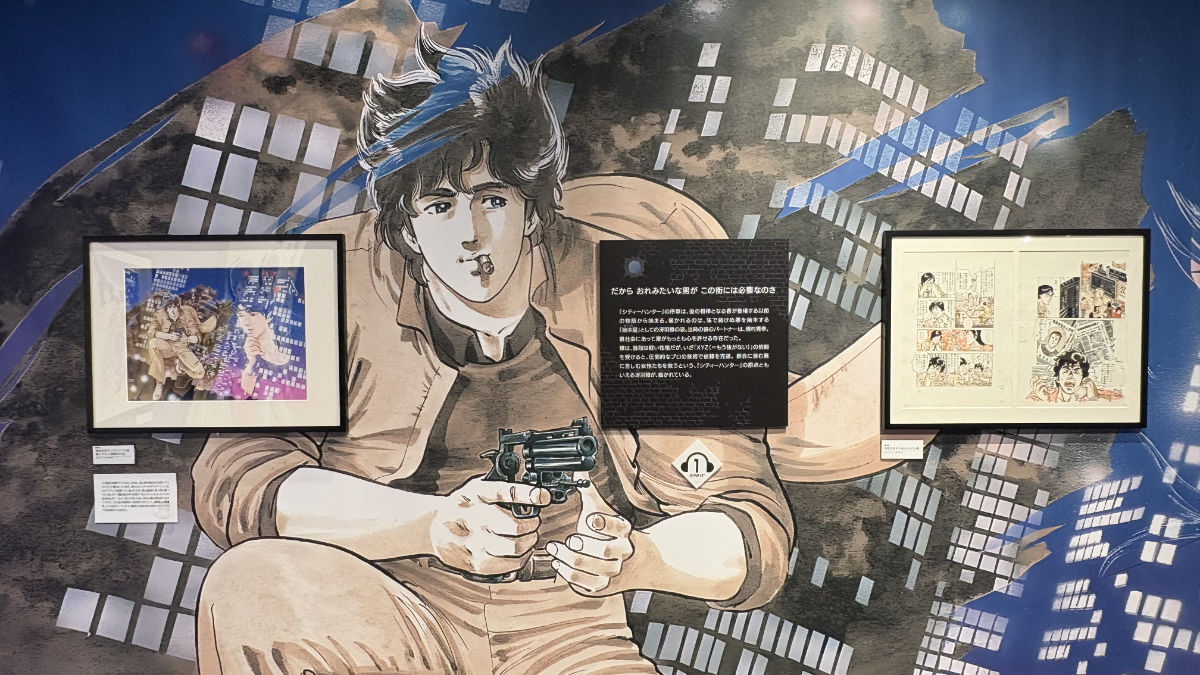
Large character visuals are placed near the original artwork, making it easy to grasp the atmosphere of each episode.
Moving your gaze from the large visual to the original page naturally draws attention to variations in line weight and correction marks that can be easy to overlook in print.
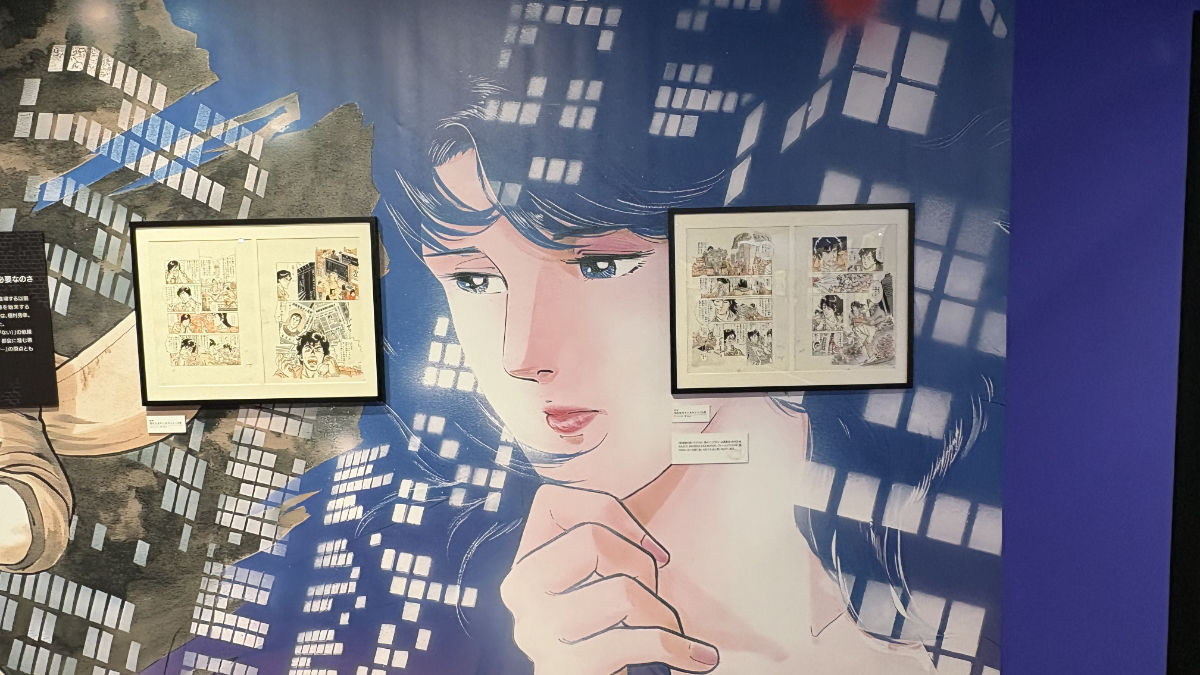
Visitors can view enlarged character expressions and original hand-drawn pages at the same time.
Looking at the original artwork beside the enlarged expressions shows how tiny lines around the eyes and mouth create a character’s emotions.
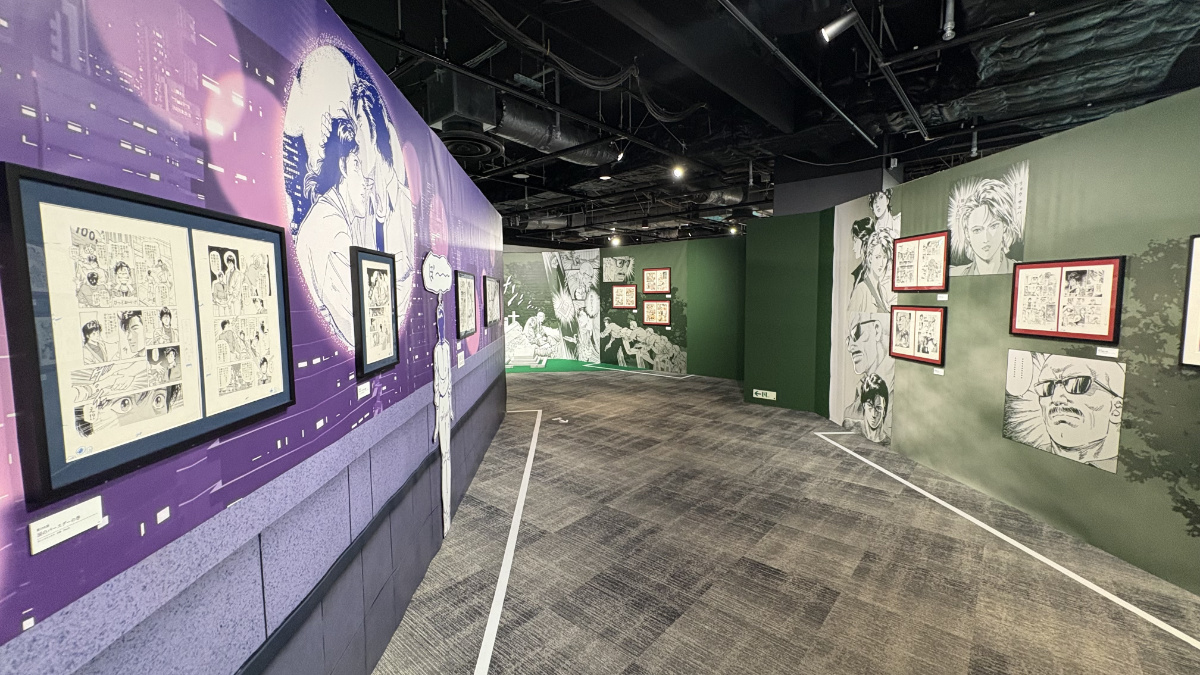
The original pages continue far down the corridor, making the scale of more than 400 works tangible.
Because there is so much to see, reading every line of dialogue will significantly extend your visit. It may help to prioritize favorite characters or episodes.
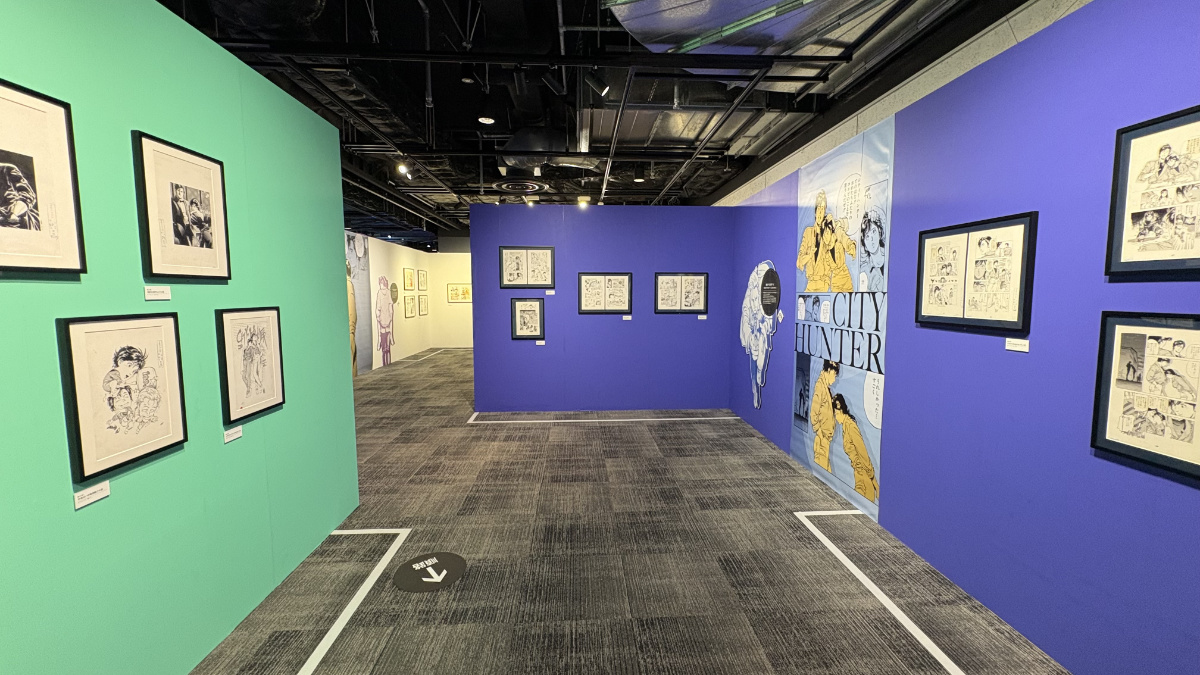
New original pages appear around every turn, and the pace of viewing changes from chapter to chapter.
Describing his first time seeing the original artwork, Yuki Hirako said, “You cannot understand the particular force these drawings have unless you see them live from this close.”
Looking at the streaks left in the solid black ink, he imagined that some areas might have been handled by Takehiko Inoue, who once worked as an assistant to Tsukasa Hojo. Hirako made clear this was only his imagination, but picturing the production process is part of the pleasure of standing before the original pages.
Not Just Ryo and Kaori: The Presence of Friends and Clients
CITY HUNTER is the story of Ryo and Kaori, but it is also the story of the friends and clients whose lives intersect with theirs.
A wall-sized image of Saeko Nogami lets visitors enjoy the character’s presence alongside the original artwork.
There is also a wealth of original artwork featuring Saeko Nogami and the many other characters who enrich the story.
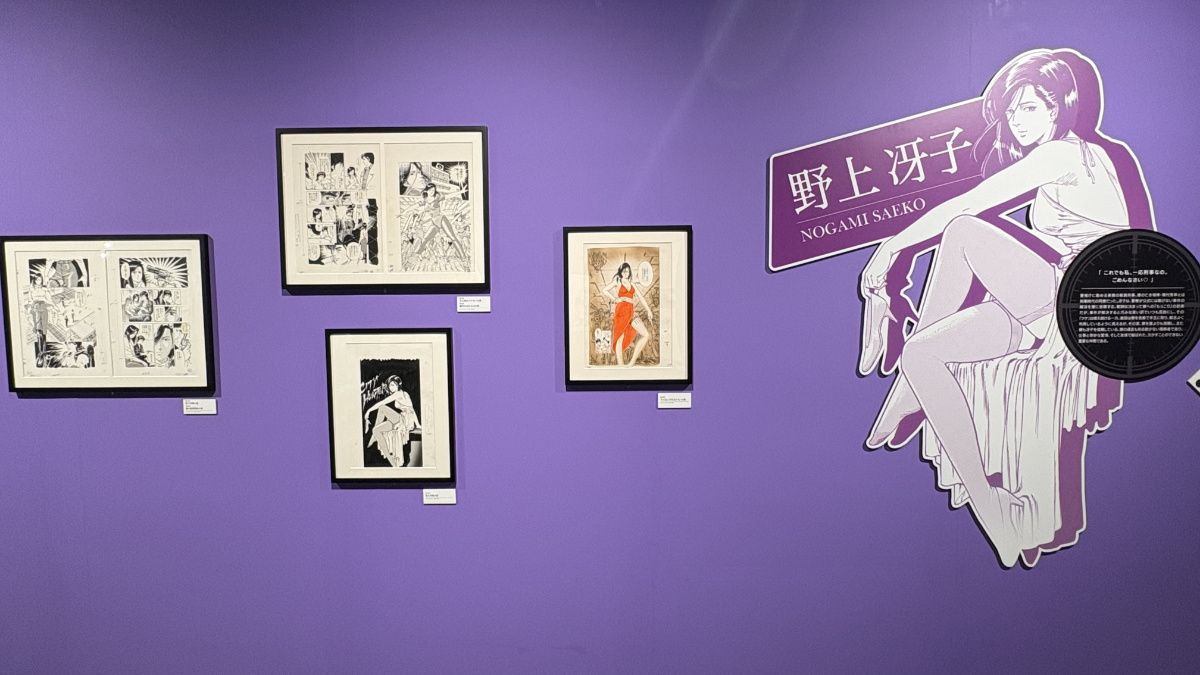
Multiple original pages revisit Saeko Nogami’s expressions and commanding poses.
Saeko trusts Ryo’s abilities while sometimes drawing him into dangerous assignments. In the original artwork, look not only at her strength but also at expressions that convey mature composure.
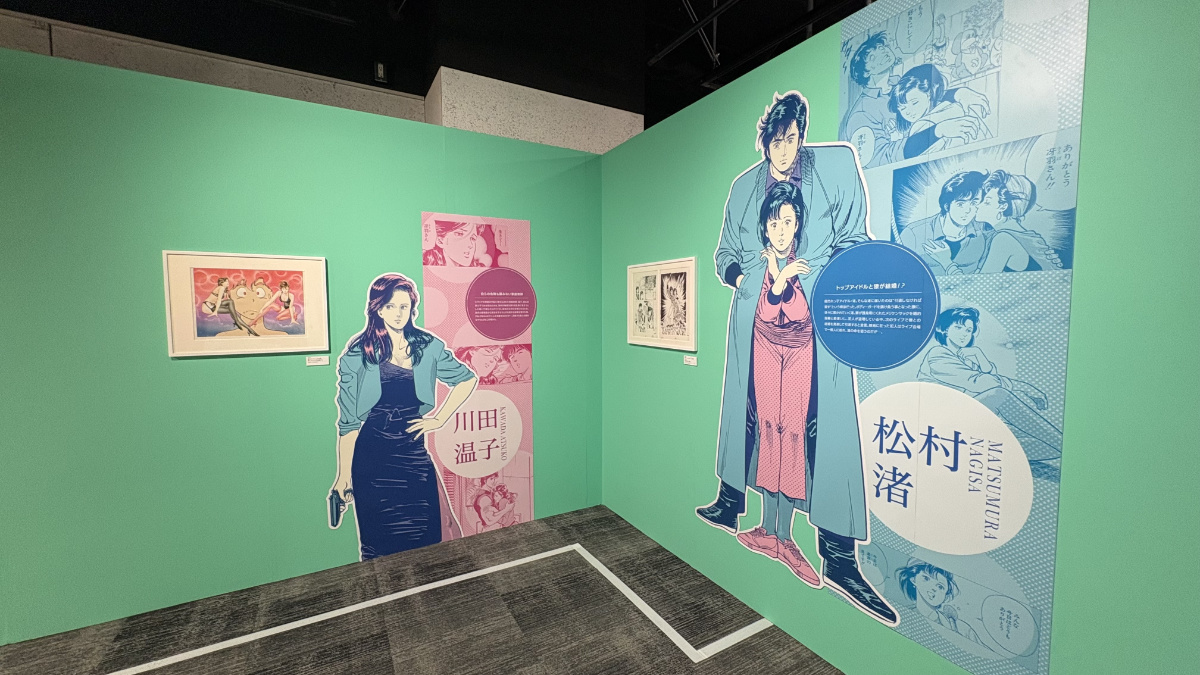
Original pages and large visuals are arranged by character, letting visitors recall their appearances as they move through the exhibition.
Clients and allies do more than drive individual cases; they also reflect the ways Ryo and Kaori think.
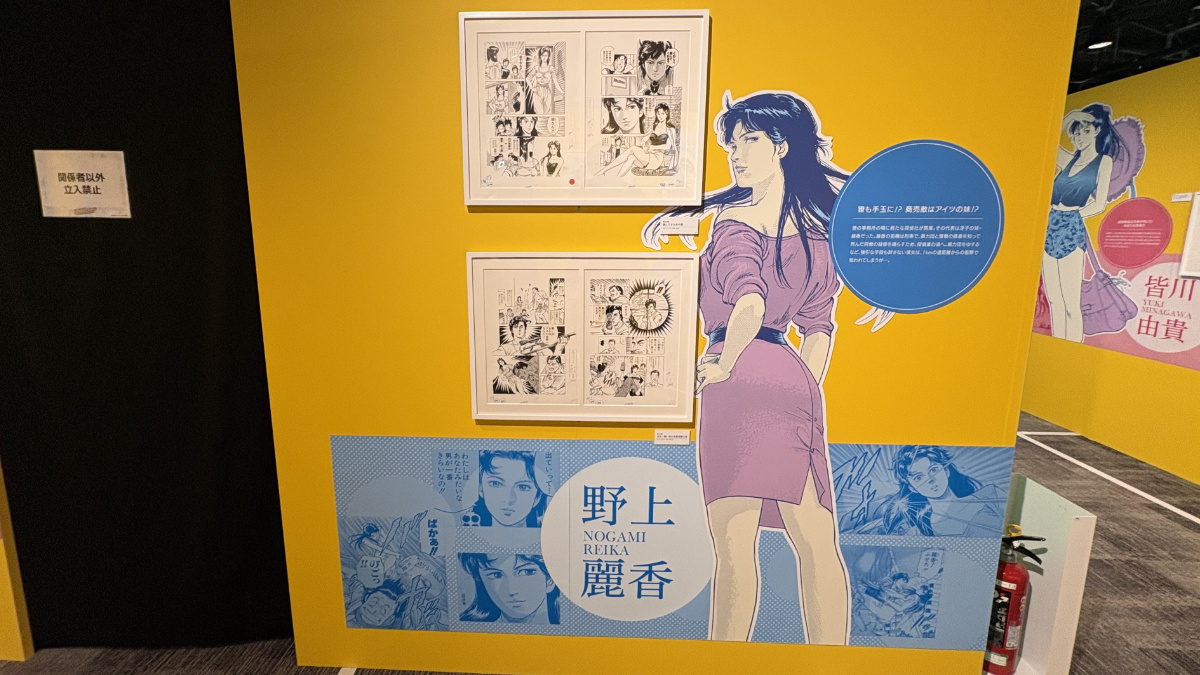
Original artwork featuring Reika Nogami, revisiting her distinct appeal and her relationship with Ryo.
Comparing the character displays shows how the lines and costumes distinguish the atmosphere of sisters Saeko and Reika.
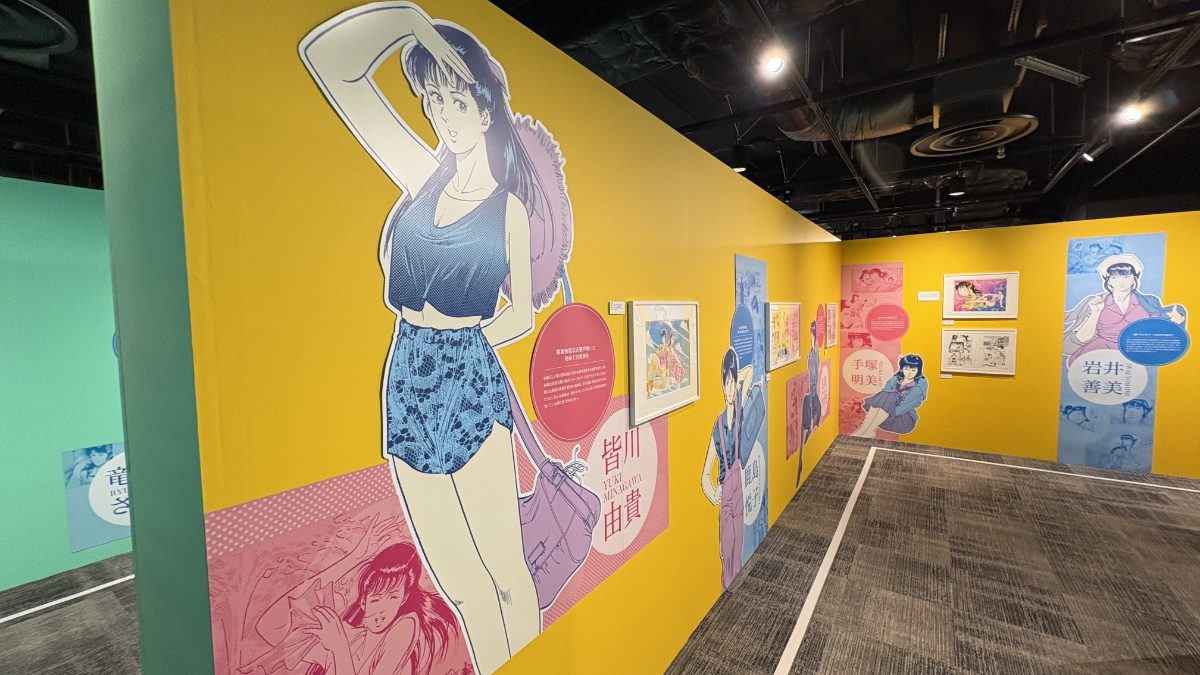
The women who appeared as allies and clients brighten the corridor.
Original artwork and large visuals revisit Saeko Nogami, Umibozu, Miki, Reika Nogami, Kasumi Aso, and other characters who have enriched the series.
Readers who followed the original serialization will likely spend time recalling the episodes in which each character appeared.
For those who discovered the series through the anime or live-action film, the display is an introduction to the manga’s remarkably diverse cast and episodes.
The Tension of Gunfights and Ryo’s Professional Side
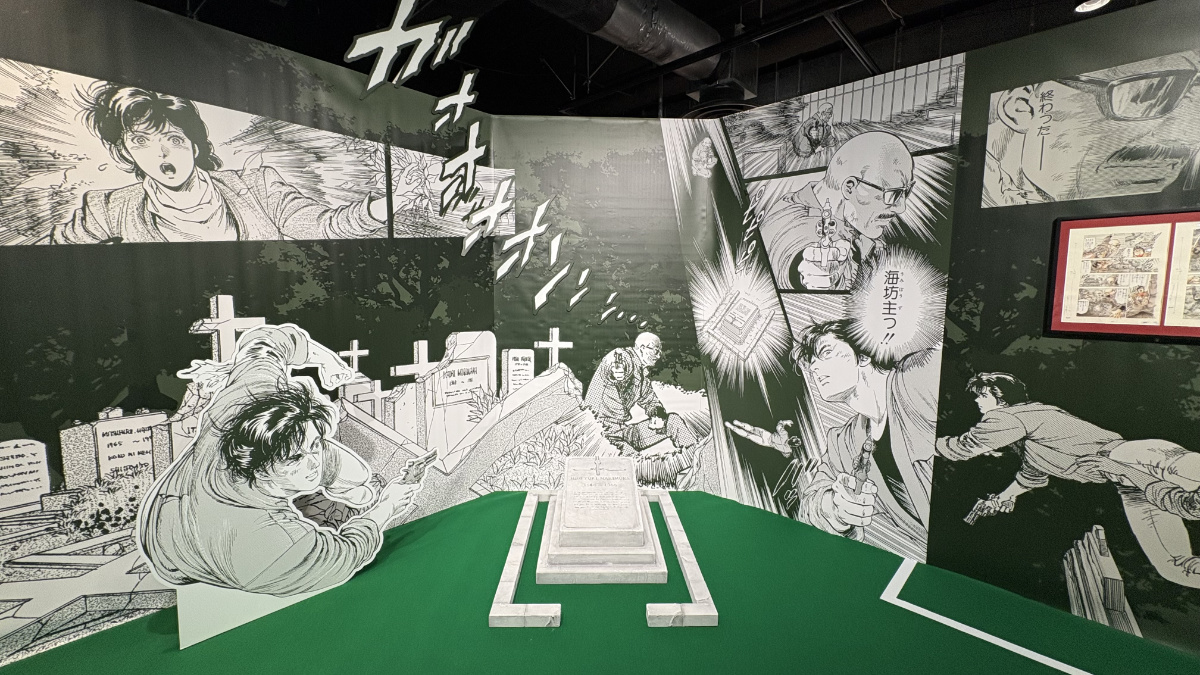
The decisive battle in which Ryo and Umibozu test each other’s skill and resolve is expressed through original artwork and three-dimensional staging.
This section depicts the showdown between Ryo Saeba and Umibozu. The two men, bound by a long history, face each other in a life-or-death battle while recognizing one another as elite professionals.
Ryo is usually obsessed with women and often sent flying by Kaori’s hammer. The moment he accepts a job and raises his gun, however, he becomes a first-rate sweeper.
That contrast is central to the appeal of CITY HUNTER. Because comedic and serious original pages can be compared at close range, Ryo’s two sides come through even more clearly.
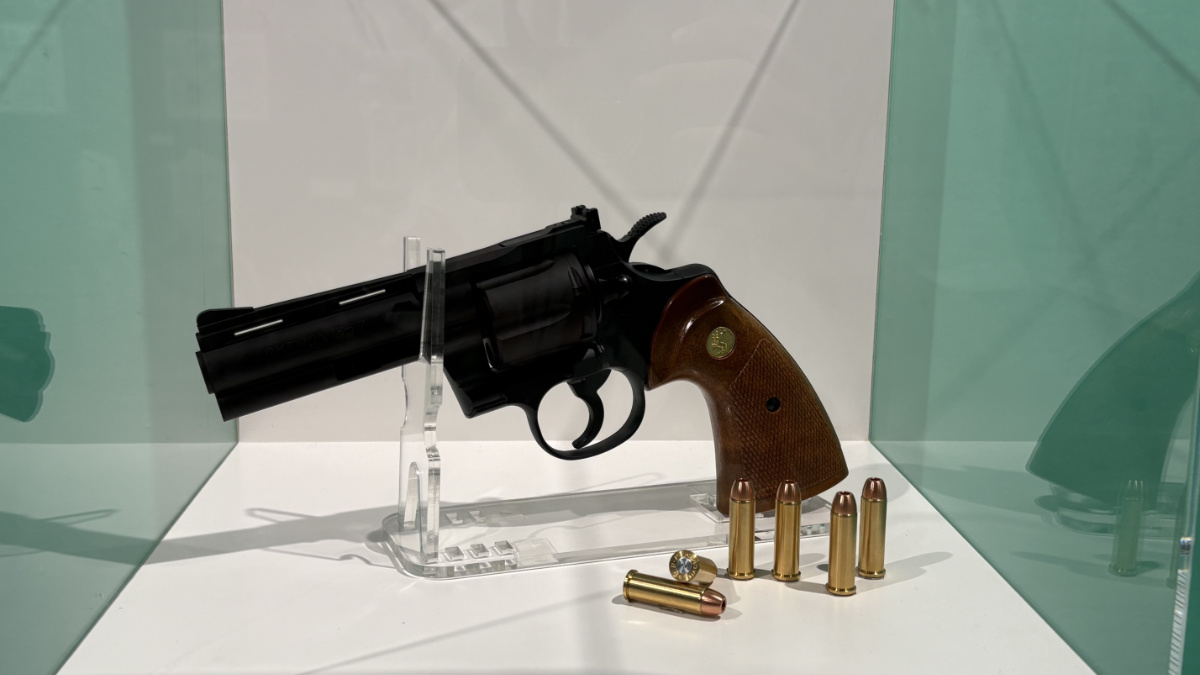
Ryo Saeba’s signature Colt Python .357 Magnum with a 4-inch barrel is displayed with ammunition.
Ryo uses a Colt Python .357 Magnum with a 4-inch barrel. It symbolizes both his shooting skill and his professionalism, and it is one of the series’ most recognizable items.
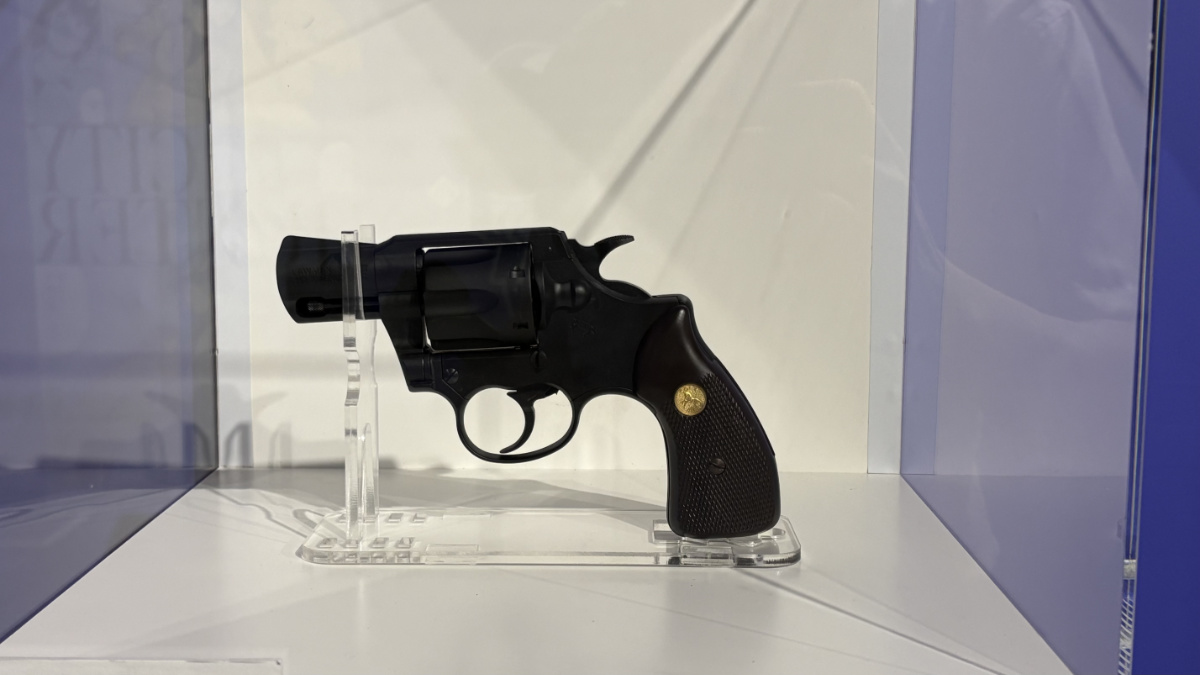
Kaori Makimura’s Colt Lawman MK III with a 2-inch barrel was a keepsake from her brother, Hideyuki Makimura.
Kaori carries a Colt Lawman MK III with a 2-inch barrel, a keepsake from her brother Hideyuki Makimura.
Ryo has altered the gun’s sights so that Kaori will not hit the person she aims at. He lets Kaori carry a gun while standing beside him in a dangerous world, yet he does not want her to shoot anyone. The modification itself shows how deeply Ryo cares for her.
Look Closely at Tsukasa Hojo’s Use of Color
Color illustrations familiar from manga volumes and magazines
The color illustrations are a highlight alongside the lines and screentone of the black-and-white pages.
Skin, clothing, the sheen of fabric, and the atmosphere of a city at night all reveal the dimensionality of Tsukasa Hojo’s characters and the urban mood of the 1980s and 1990s at a distance impossible in print.
When standing before an original, first take in the whole image, then shift your attention to the expression, hands, clothing, and background to appreciate the density of detail.
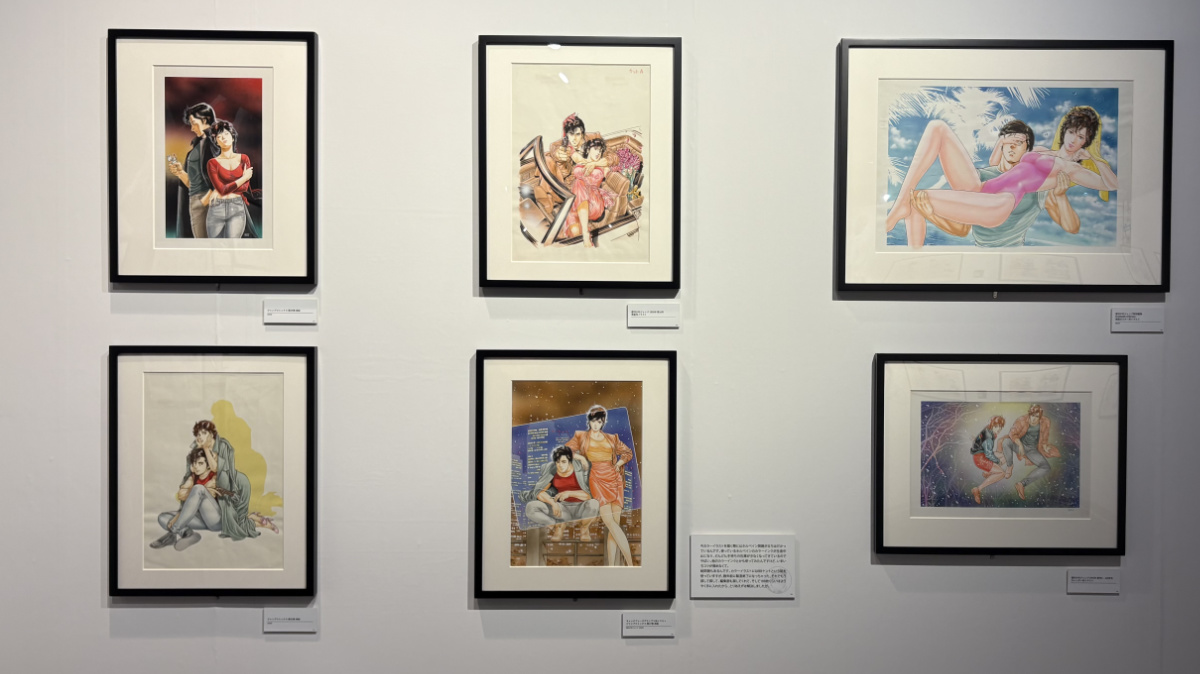
This display lets visitors compare color, costumes, and even the distance between characters.
In the Second Half, Ryo and Kaori Grow Closer and the Famous Scenes Gain Weight
As you move through the exhibition, you can see the distance between Ryo and Kaori change.
Kaori first becomes Ryo’s partner as though taking over her brother Makimura’s role, but eventually becomes someone irreplaceable to him. The exhibition traces that change through famous scenes and lines.
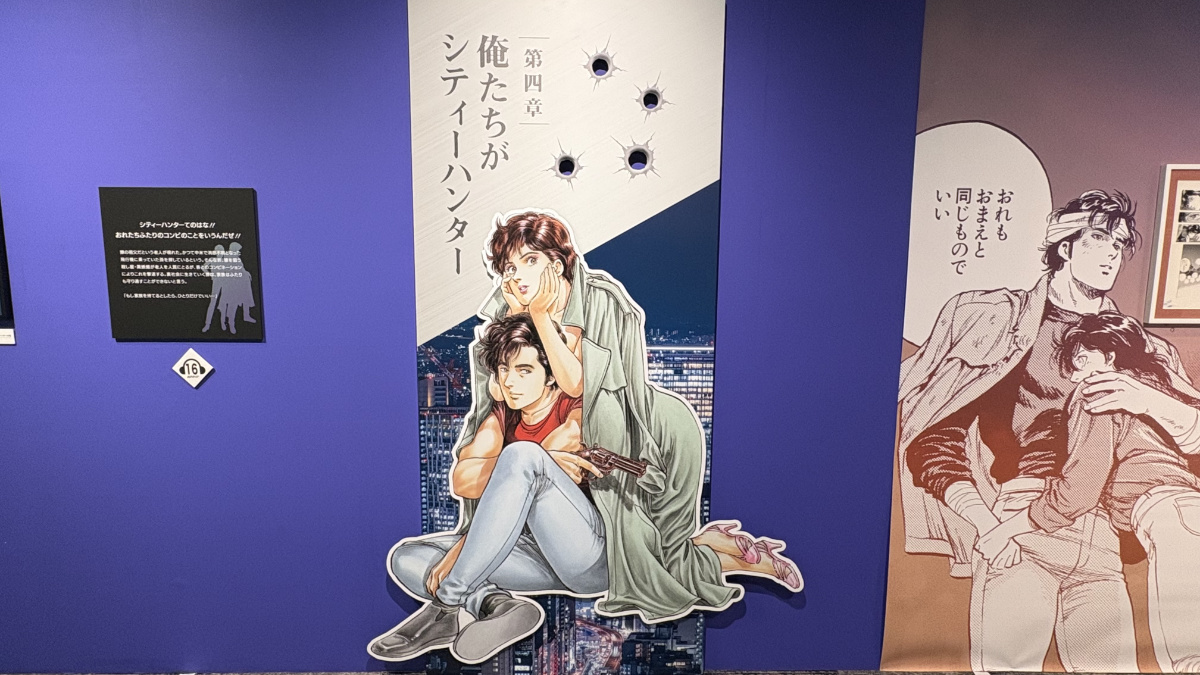
The image of the two declaring “We are City Hunter” serves as the entrance to the second half of the exhibition.
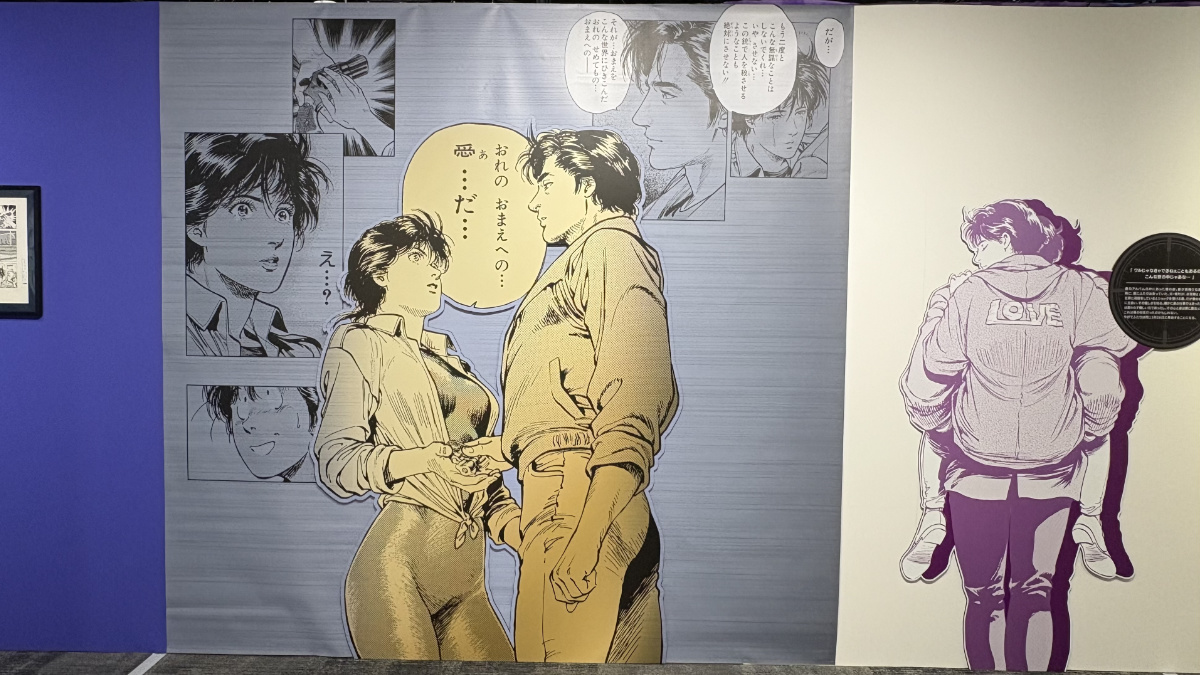
From this point, the focus shifts from the highlights of individual cases to how Ryo and Kaori see one another.
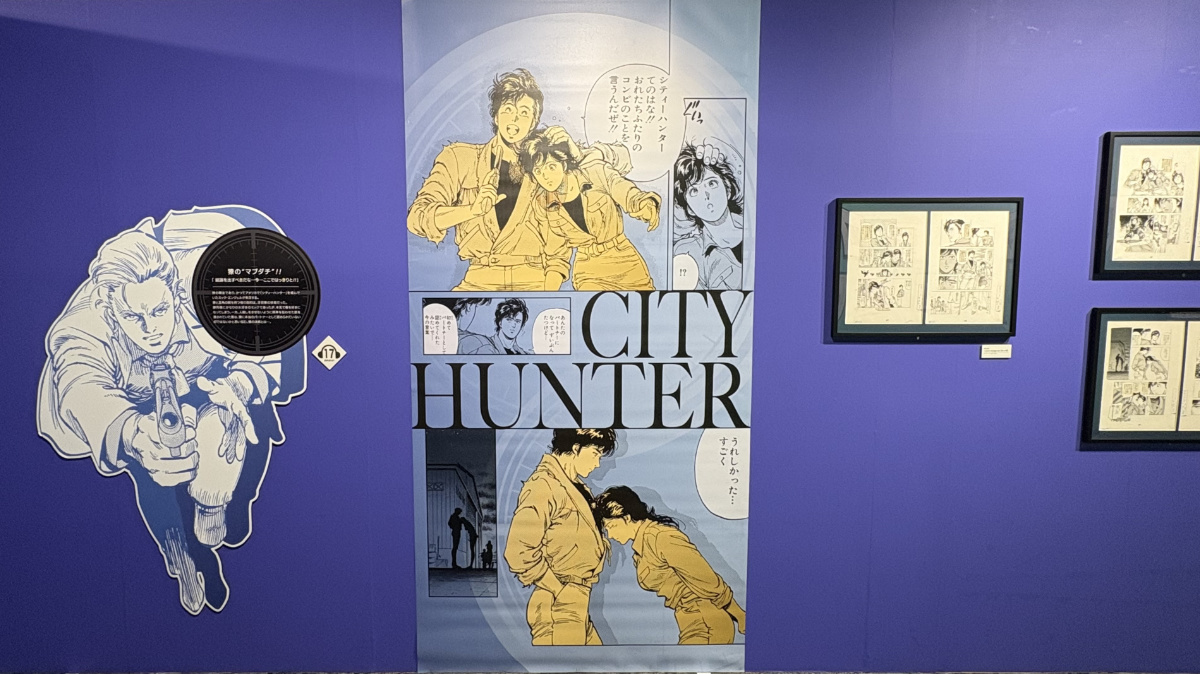
Original pages focusing on Ryo and Kaori’s relationship are arranged along the flow of the chapters.
The more completely you know the original story, the longer you may find yourself standing before a single page.
Knowing what happens later gives new meaning to even casual conversations from the early chapters. At the same time, visitors unfamiliar with the manga can easily follow how the relationship changes by moving through the exhibition in order.
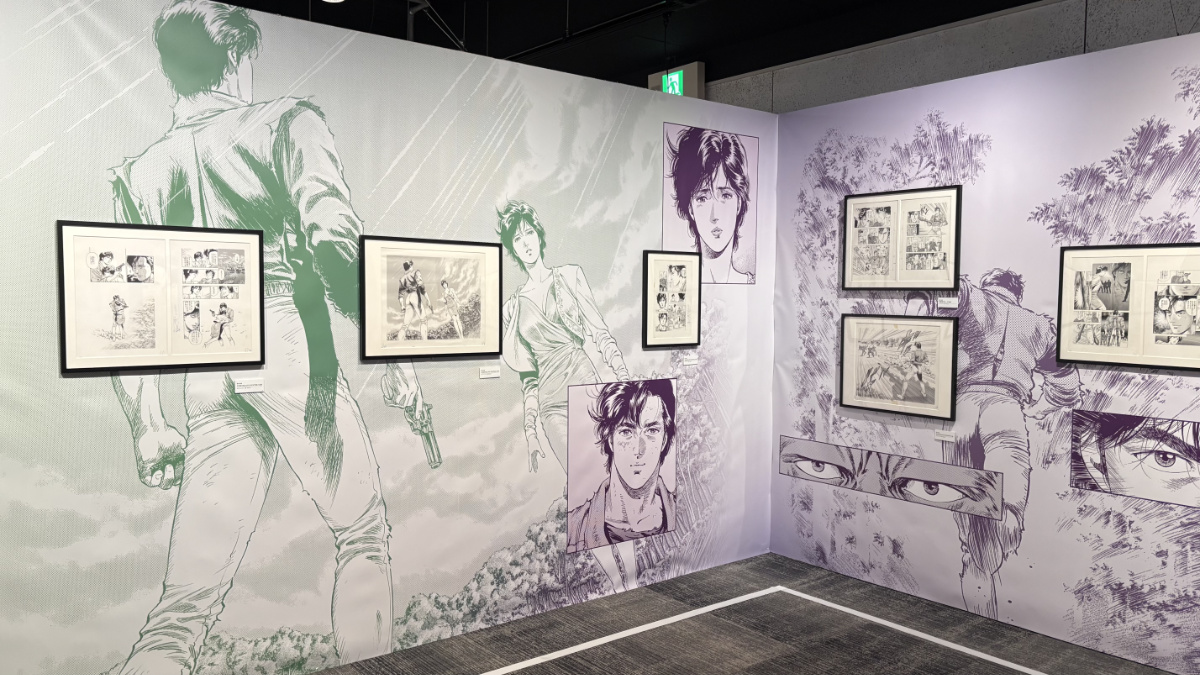
The later-story artwork also revisits the relationships with the friends who support the two.
Even Yuki Hirako Says He “Cannot Step In” to the Famous Scene Through Glass
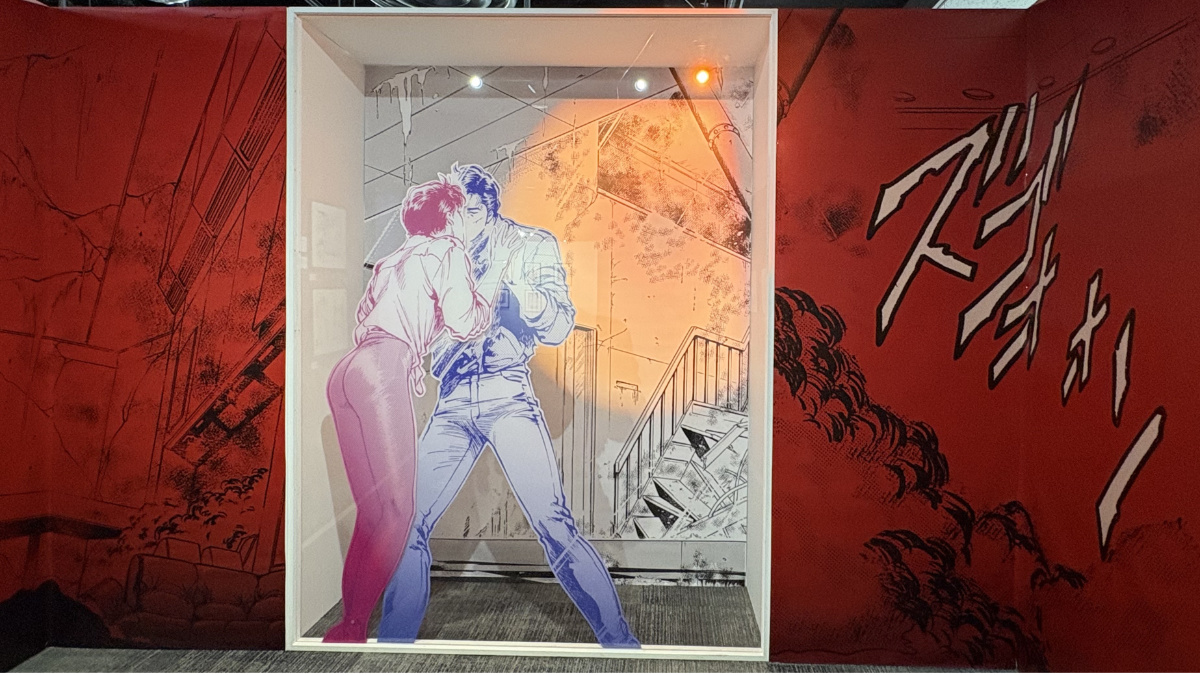
Transparent panels give a scene from the manga depth and create the feeling of stepping inside it.
One exhibit Hirako said everyone absolutely had to see is the photo spot recreating the scene between Ryo and Kaori through glass.
Visitors can stand between the two for a photo, but Hirako, a devoted fan of the manga, said, “I cannot do that. I cannot put myself in the picture,” because he did not want to disturb their private world.
One approach is to photograph the display alone first, then take another photo with yourself in it. That order may satisfy both fan sentiment and the desire for a commemorative picture.
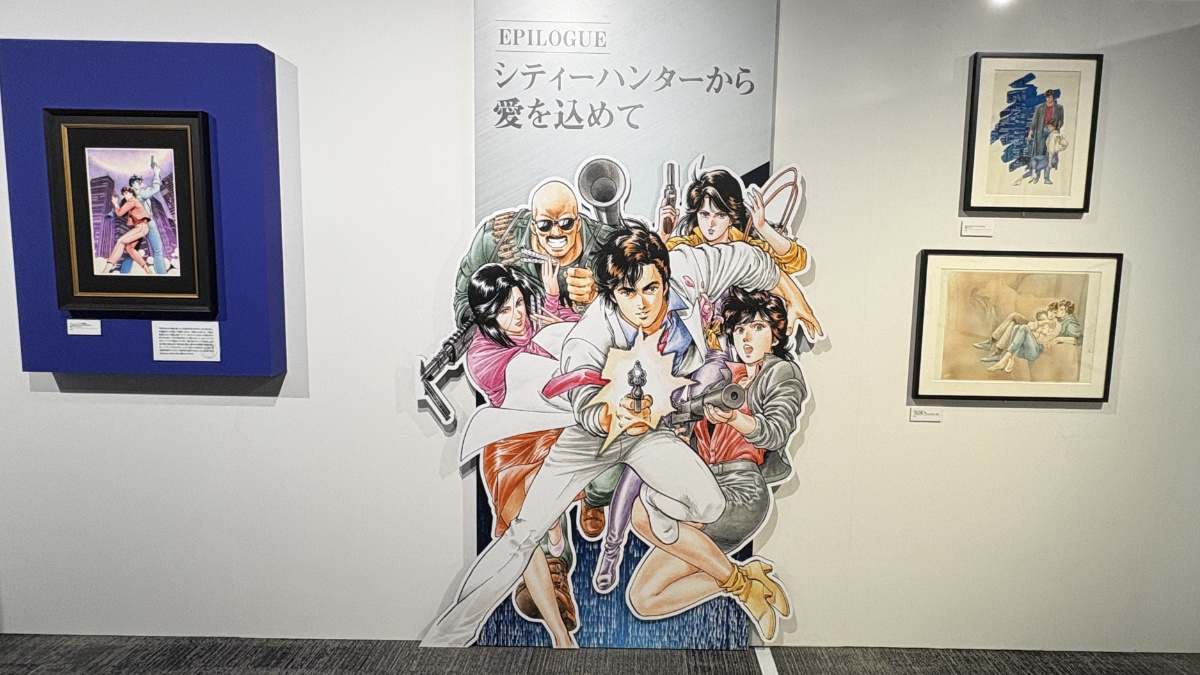
The epilogue gathers characters who shaped the story and offers a final look back over the exhibition.
After revisiting the friends and clients they met, the exhibition leads into a space that brings Ryo and Kaori’s story to a close.
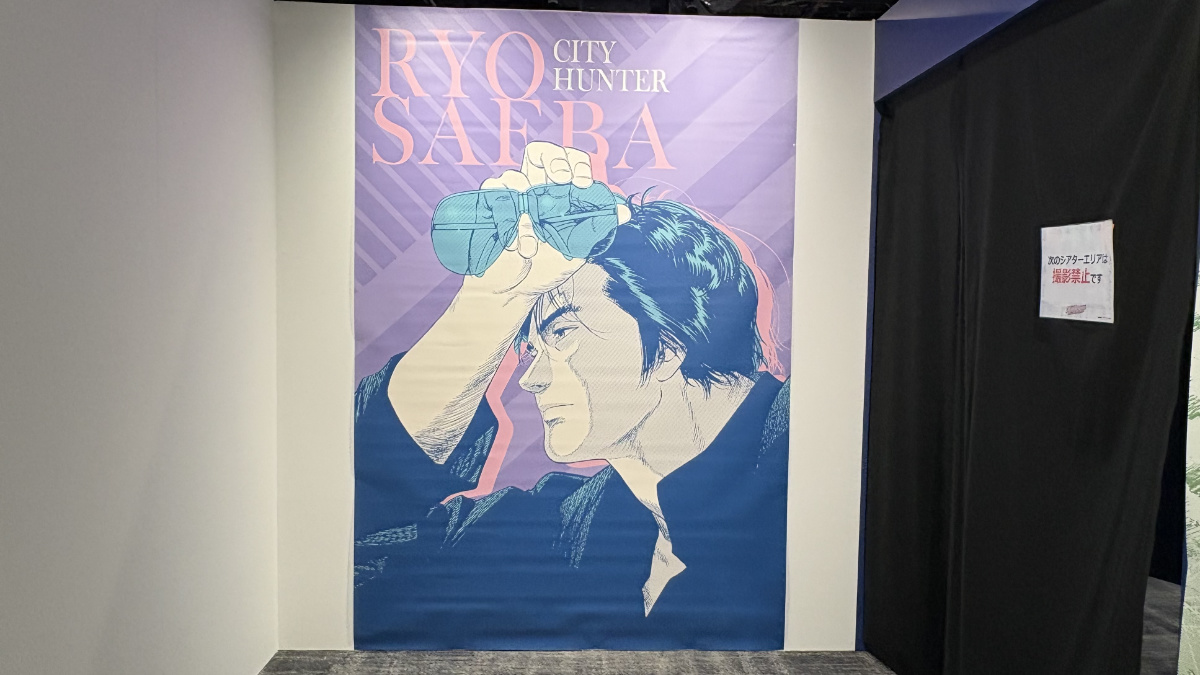
Passing through the curtain symbolizing Ryo and Kaori’s story takes visitors into the final part of the exhibition.
Experience the Special Video and “Get Wild” Without Knowing What Happens
Near the end of the exhibition is a section that looks back on the appeal of CITY HUNTER through video and music.
Hirako enthusiastically described one sequence in which a certain scene meets “Get Wild,” saying fans might be moved enough to collapse to the floor in tears.
This article will not reveal the exact scene. Experience at the venue the moment when the memories built through the manga and anime merge with the music.
Must-Visit Photo Spots
It is best to think separately about time for closely viewing the original artwork and time for taking photos.
When visiting with two or more people, each spot can take longer because people switch between photographer and subject. If others are waiting, decide on the composition before shooting to keep things moving smoothly.
The Saeba Apartment Underground Shooting Range and the “Final Shooting Lesson”
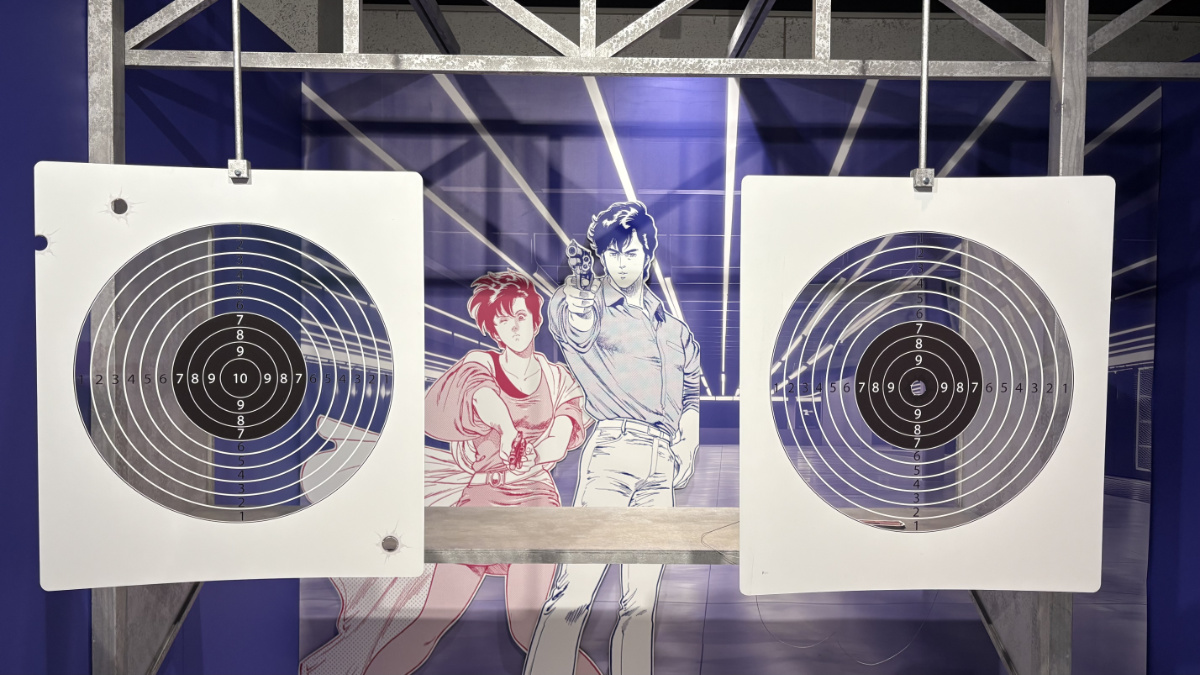
This photo spot recreates the underground shooting range beneath the Saeba apartment, where visitors can photograph the target together with Ryo and Kaori.
The underground range where Ryo and Kaori practice shooting is recreated as a space with real depth.
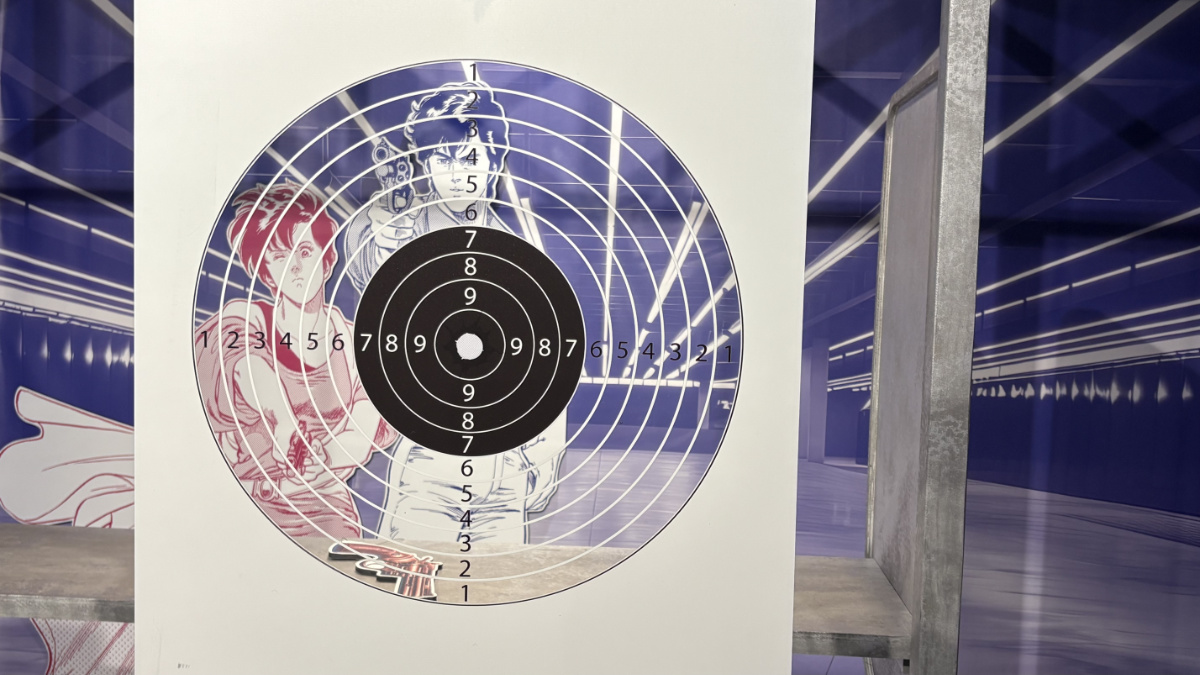
The visual of Ryo and Kaori can be seen beyond a target marked with bullet holes.
Including the target and lighting in the frame creates a photo that feels as though you have entered the scene.
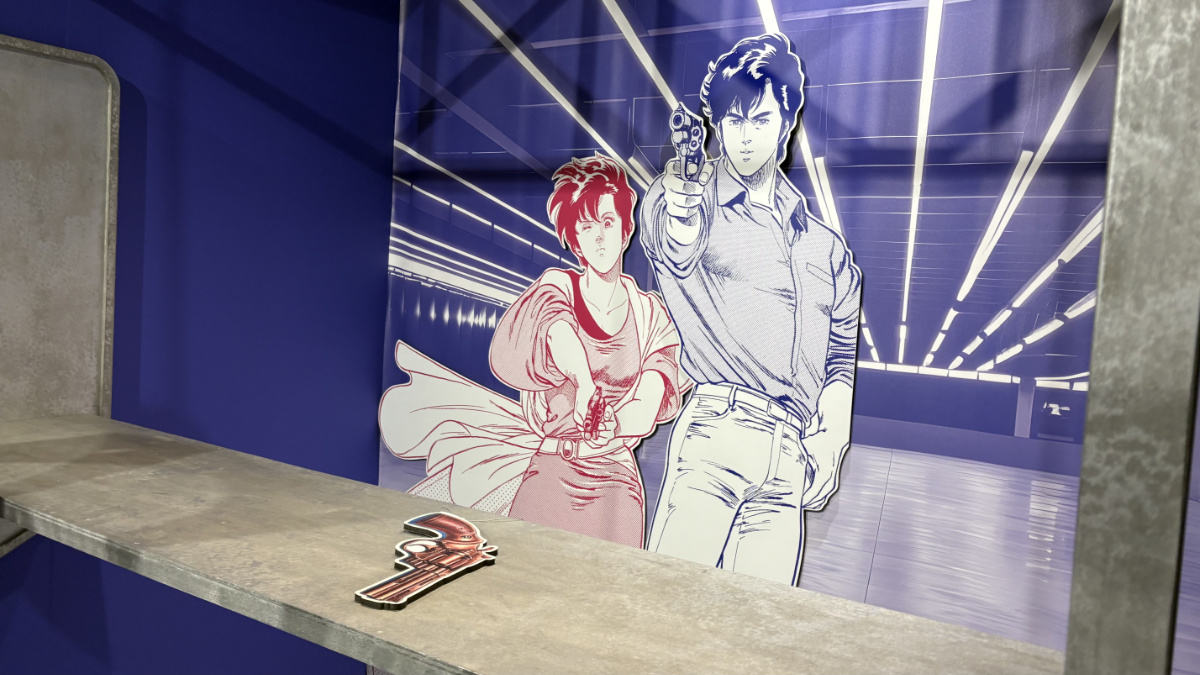
Changing your shooting position lets you capture Ryo and Kaori standing beyond the target in a single frame.
For a full-body shot, the photographer will need to step back slightly. If others are waiting, decide in advance whether to shoot vertically or horizontally.
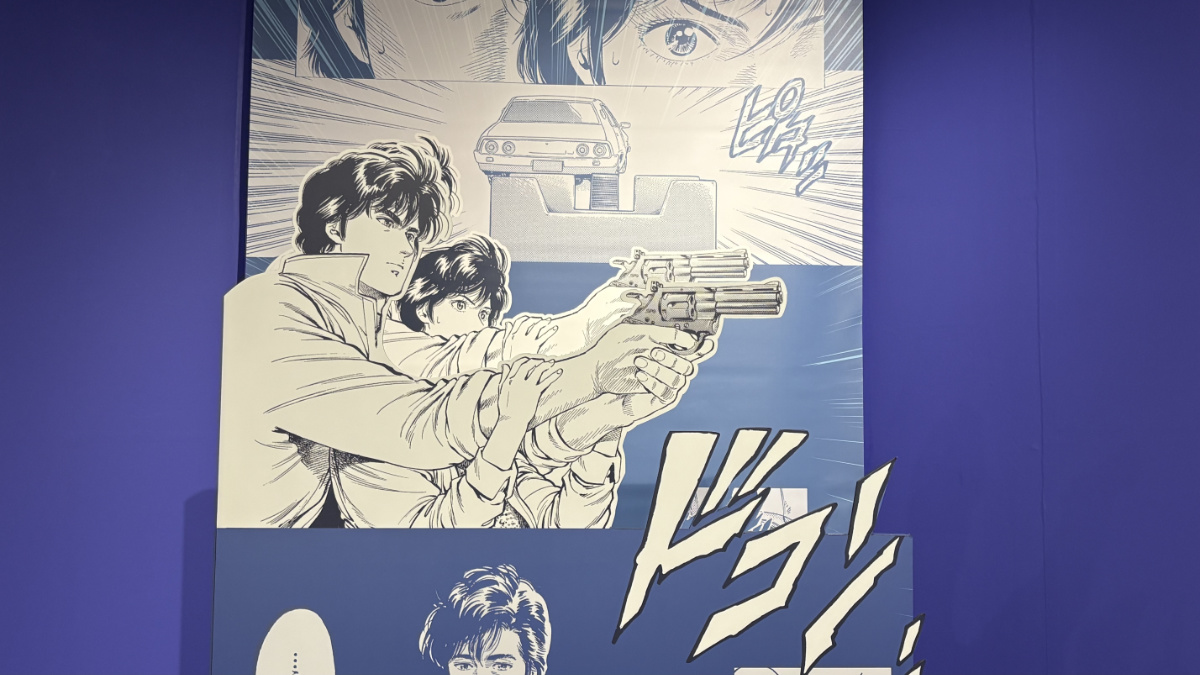
This photo spot recreates the “Final Shooting Lesson,” in which Ryo teaches Kaori how to hold a gun.
The scenes recreated in cityhunterten53.jpg and cityhunterten54.jpg depict Kaori’s final shooting lesson.
Before facing Mick Angel, the most powerful assassin targeting Ryo, Ryo entrusts Kaori with the “last bullet” and teaches her how to fire a gun. Beyond the tension of the coming battle, the scene symbolizes Ryo’s trust in Kaori and his willingness to place his life in her hands.
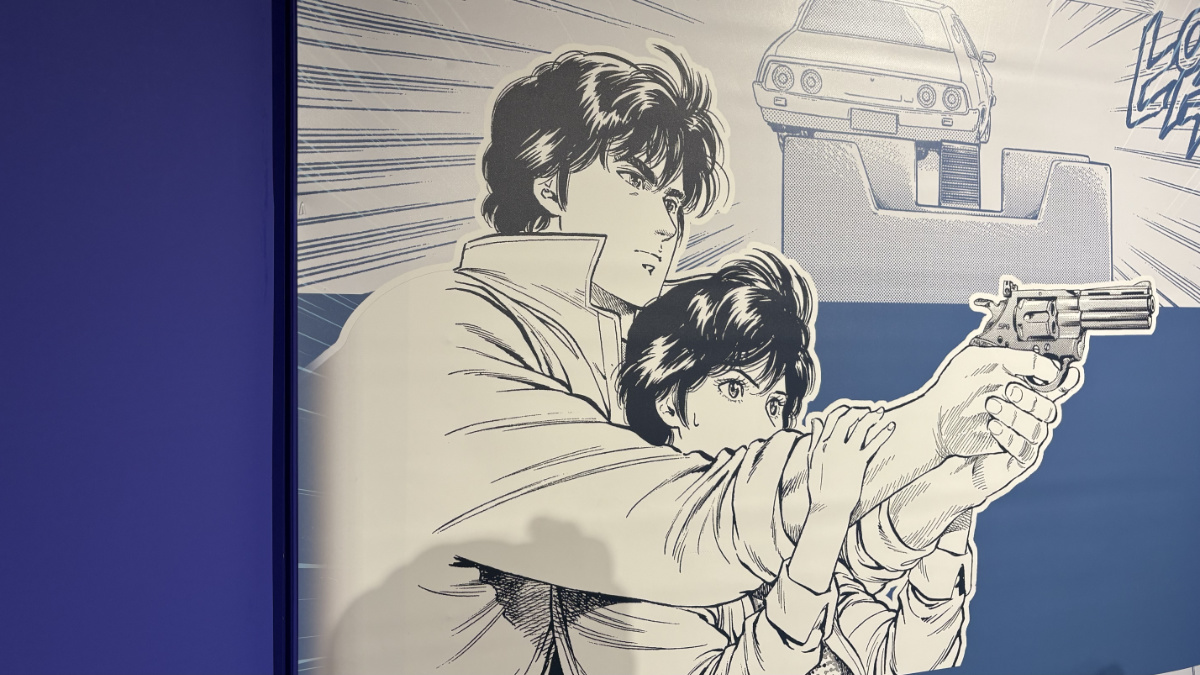
Visitors can take a large-format photo of Kaori aiming the gun in Ryo’s arms.
You can photograph the scene by itself or stand beside it for a picture. Those who want a clean record of the original scene should photograph the display alone first.
Café Cat’s Eye
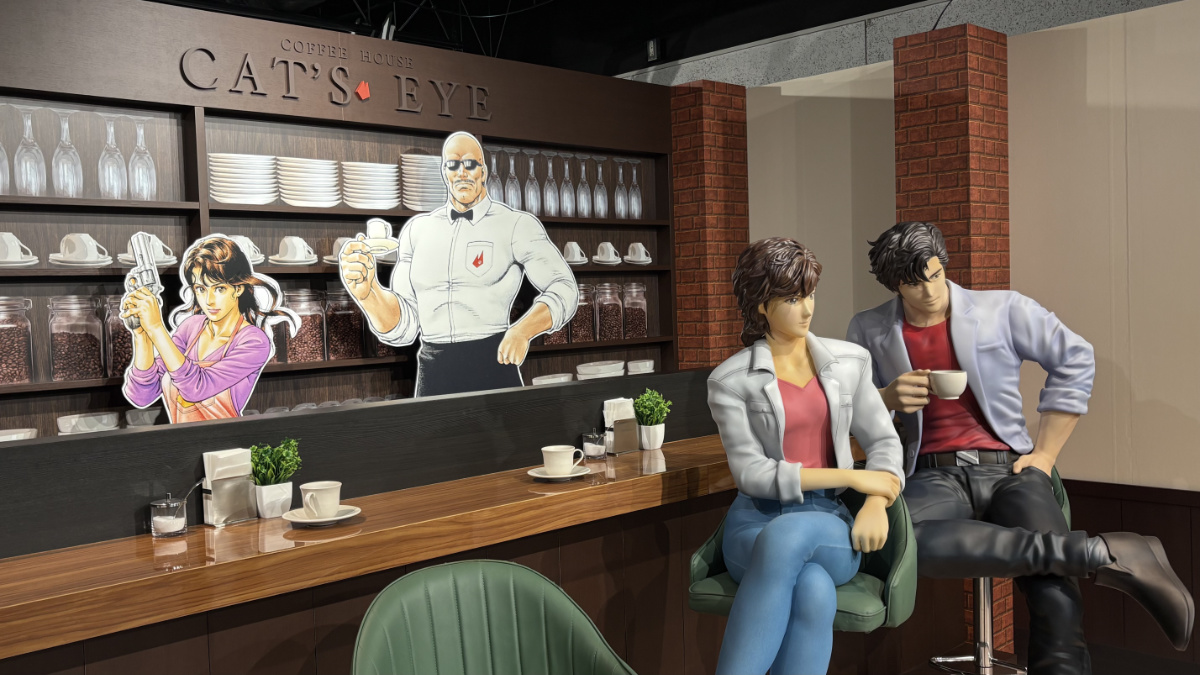
Café Cat’s Eye is recreated down to the counter and shelves, with Umibozu, Miki, Ryo, and Kaori together.
Café Cat’s Eye, run by Umibozu, is recreated with a counter, shelves, and life-size characters.
The spot supports many compositions: sitting beside Ryo, framing Kaori and Ryo together, or taking a wide shot that includes Umibozu and Miki.
Hirako’s talk event was also held in front of this Café Cat’s Eye display.
The Shinjuku Station Message Board and 100-Ton Hammer
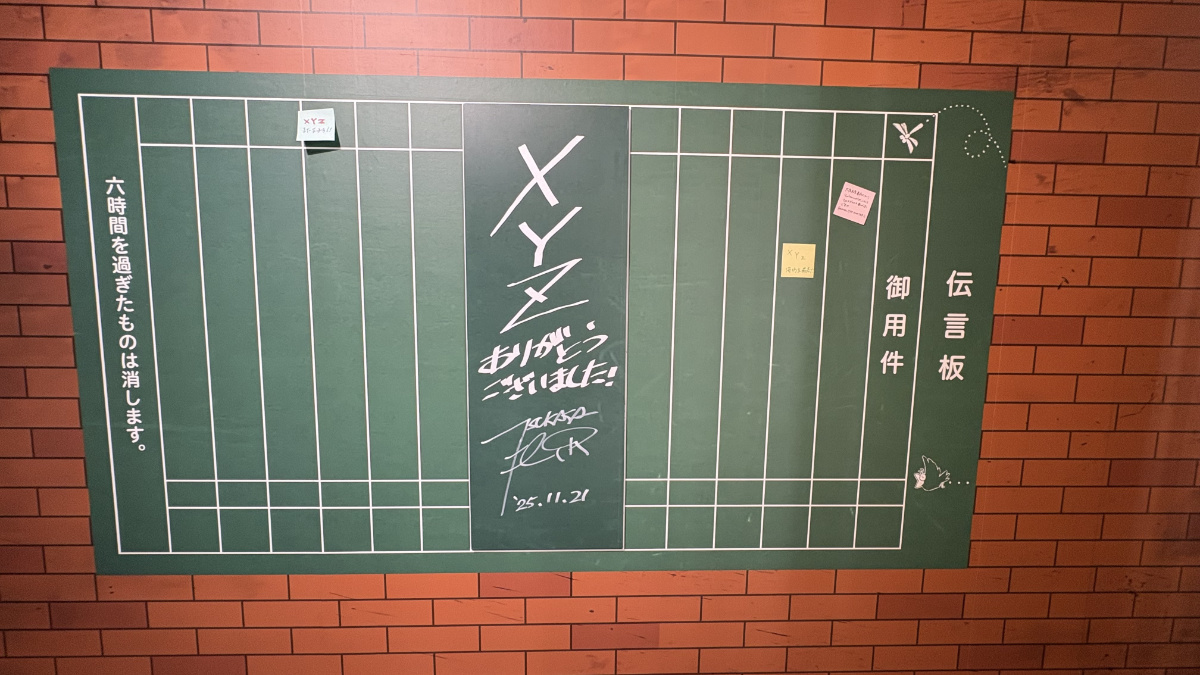
The message board bears “XYZ” and messages commemorating visitors’ trips, making it a symbolic place to photograph your entrance into the world of the series.
The message board and 100-ton hammer near the entrance are easy-to-understand photo spots even for companions who do not know CITY HUNTER well.
If the area is crowded just after you enter, ask staff whether you can return later rather than stopping and blocking the flow. Re-entry is not allowed after leaving.
Photography Rules Inside the Venue
- Photos may be taken with mobile phones, smartphones, and tablets
- Digital cameras, DSLR cameras, camcorders, and GoPro cameras are not permitted
- Some exhibits may not be photographed
- Avoid close-ups of the artwork alone; include the surrounding walls or exhibition space in the frame
- Flash, video recording, audio recording, tripods, and selfie sticks are prohibited
- Do not obstruct other visitors while taking photos
Yuki Hirako of Alco & Peace Shares His Love for CITY HUNTER
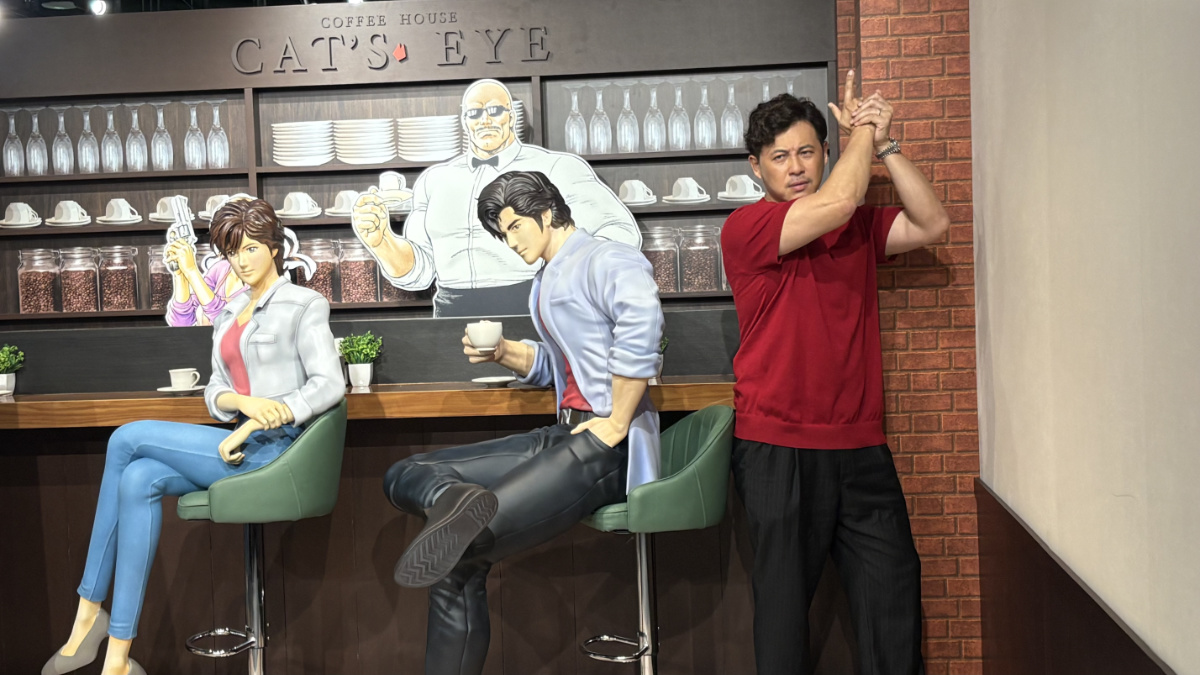
Yuki Hirako of Alco & Peace appeared in a red shirt inspired by Ryo Saeba.
Yuki Hirako of Alco & Peace, a devoted fan of the manga, appeared at the preview held the day before opening.
He arrived in a red shirt inspired by Ryo Saeba, but the jacket prepared for him reportedly did not fit. Hirako joked that he looked “like Umibozu who failed to become Ryo Saeba,” and the talk began.
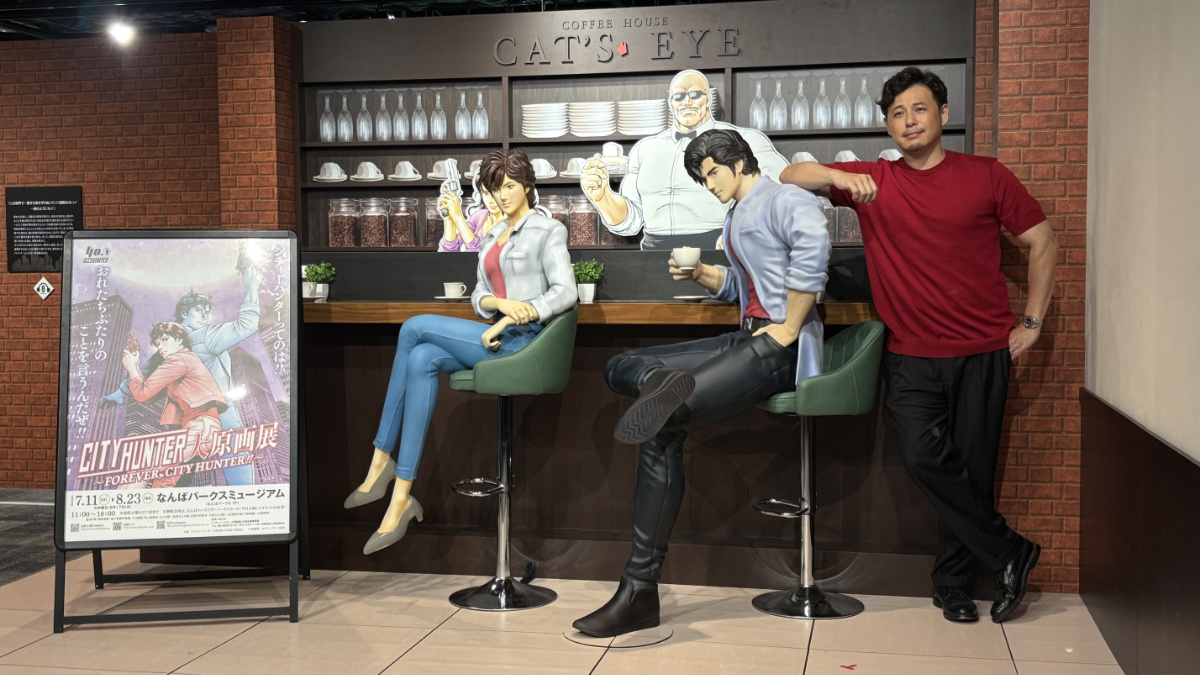
He spoke passionately about his love for the series for about 20 minutes, including the story of the jacket that did not fit.
How Elementary-School-Age Hirako Was Drawn into CITY HUNTER
Hirako had been reading Weekly Shonen Jump since elementary school.
He did not immediately gravitate toward CITY HUNTER, however. He recalled that the realistic gekiga-style artwork did not initially feel especially accessible to children, and his classmates also kept some distance from it at first.
That changed when some of the more mature girls in his class began saying, “Ryo Saeba is so cool.” The boys followed the girls’ interest, began reading, and discovered how fresh the series felt.
Tense cases and Ryo’s foolish behavior. The face of a professional risking his life, and everyday life in which Kaori punishes him with a 100-ton hammer.
Hirako said children at the time became absorbed in the series precisely because it contained that range rather than only one side.
After Seeing the Venue: “It Was Made by People Who Absolutely Love CITY HUNTER”
After touring the exhibition, the first thing Hirako felt was the love the creators of the display had for the series.
Beyond the original artwork, the venue includes multiple recreations of scenes fans remember, the kind that make you think, “They really built this part properly.” He felt it had been made by people who had studied both the manga and anime and understood what would strike a chord with fans.
He was also surprised by how many original pages were on display—more than he had imagined.
Even images seen countless times in manga volumes, magazines, and anime feel entirely different as original manuscripts. You can see where printed lettering was pasted over handwritten dialogue, small areas extending beyond the intended edge, and streaks in solid black ink. Hirako said these details let him imagine the artists’ hand movements during production.
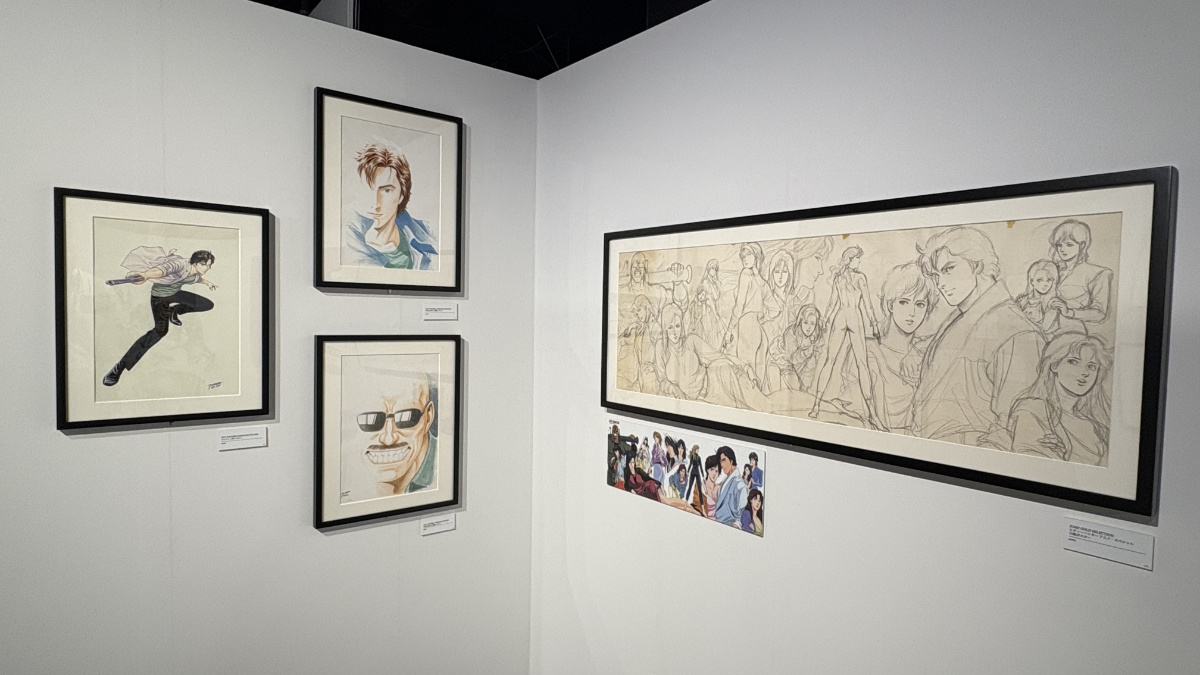
Original artwork revealing character sketches and the production process. Hirako also focused on the lines and traces of solid black ink.
For Hirako, Ryo Saeba’s Appeal Combines “Tora-san” and the “Professional”
Hirako was inspired to become a comedian by Tora-san from the film series Otoko wa Tsurai yo.
Tora-san is usually a troublemaker, weak around women, and clumsy. Yet he is deeply compassionate and rises to the occasion when it matters. Hirako sees a shared appeal between Tora-san and Ryo Saeba.
Ryo also has the cool competence of a professional who always completes the job.
He may seem shameless around women, but when one closes the distance, he sometimes becomes embarrassed and quietly steps away. Hirako said he also senses a “masculine code” in that behavior.
Favorite Character: Kaori Makimura, a Refreshing Short-Haired Heroine
Kaori Makimura is Hirako’s favorite character.
At a time when manga heroines often seemed to be drawn with long, flowing hair, Kaori was short-haired and athletic. She appears tomboyish yet is portrayed as so attractive that the men around her cannot ignore her.
Ryo does not honestly recognize her appeal, while readers watch from a slight distance and grow impatient with the space between them.
Hirako said he had been drawn to Kaori since childhood and called her “the pioneer who opened a new door for people who love short hair.”
He also finds human appeal in the detail that Kaori keeps her hair short because she is self-conscious about its natural curl. She is not simply a strong, cool heroine; her insecurities and awkwardness are what make so many readers want to support her.
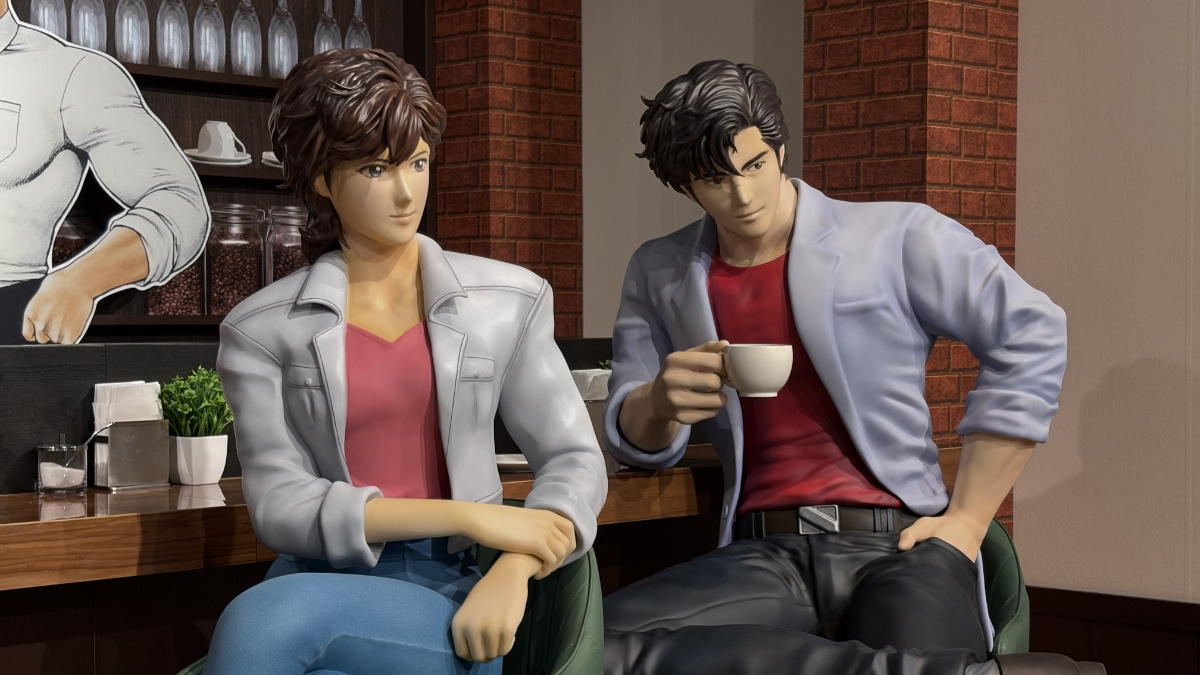
Kaori and Ryo sit beside each other at Café Cat’s Eye. Their closeness, despite their inability to be honest with each other, is another part of the series’ appeal.
Favorite Episode: The Story in Which Ryo Becomes Aware of Kaori as a Woman
The episode Hirako remembers most features Kaori’s classmate, fashion designer Eriko Kitahara, who asks Kaori to model.
Hirako suggested this may have been one of the earliest important depictions of Ryo becoming unsettled as he recognizes Kaori’s attractiveness as a woman.
It is an episode in which the distance between the two, whom readers had long been rooting for, seems to narrow slightly.
The episode also touches on the secret of the heavy long coat Ryo wears year-round. Because it reveals not only a change in the romance but also a mystery that had intrigued longtime readers, Hirako recalled that fans may regard it as one of the series’ greatest episodes.
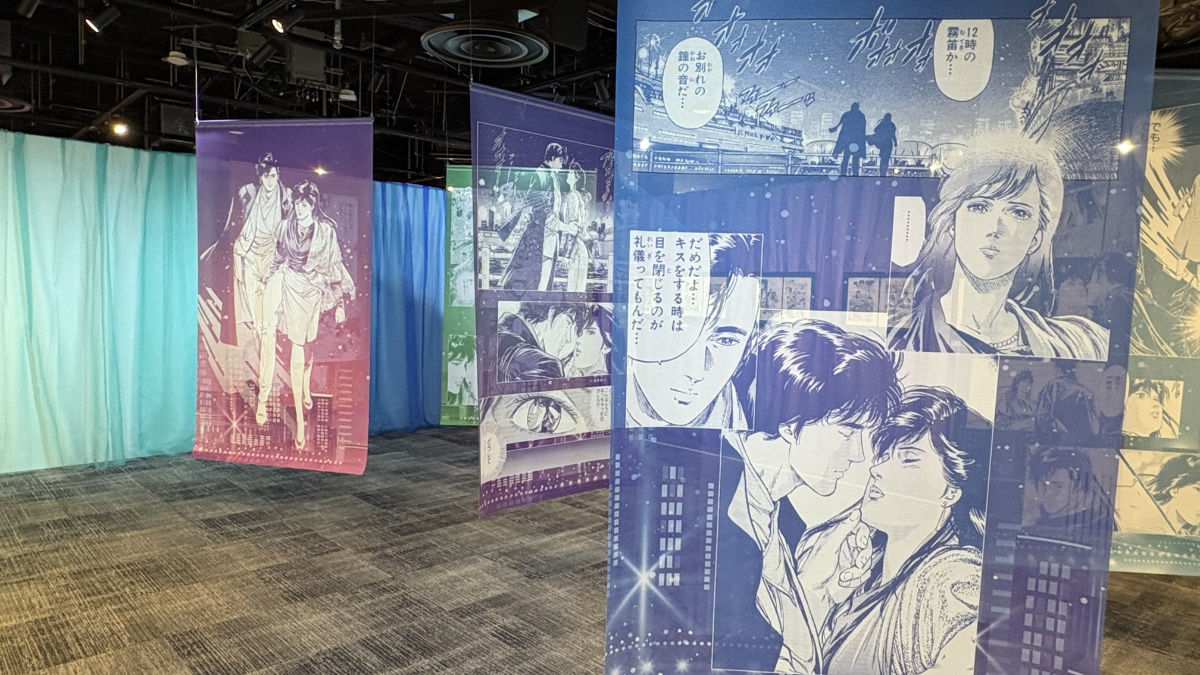
Sheer curtains and large visuals depict the episode in which Ryo and Kaori go on a date with Kaori looking different from usual.
The venue’s sheer curtains and large visuals give this episode three-dimensional depth. Seeing Ryo date a Kaori who looks different from her usual self conveys the beginning of his awareness of her as a woman.
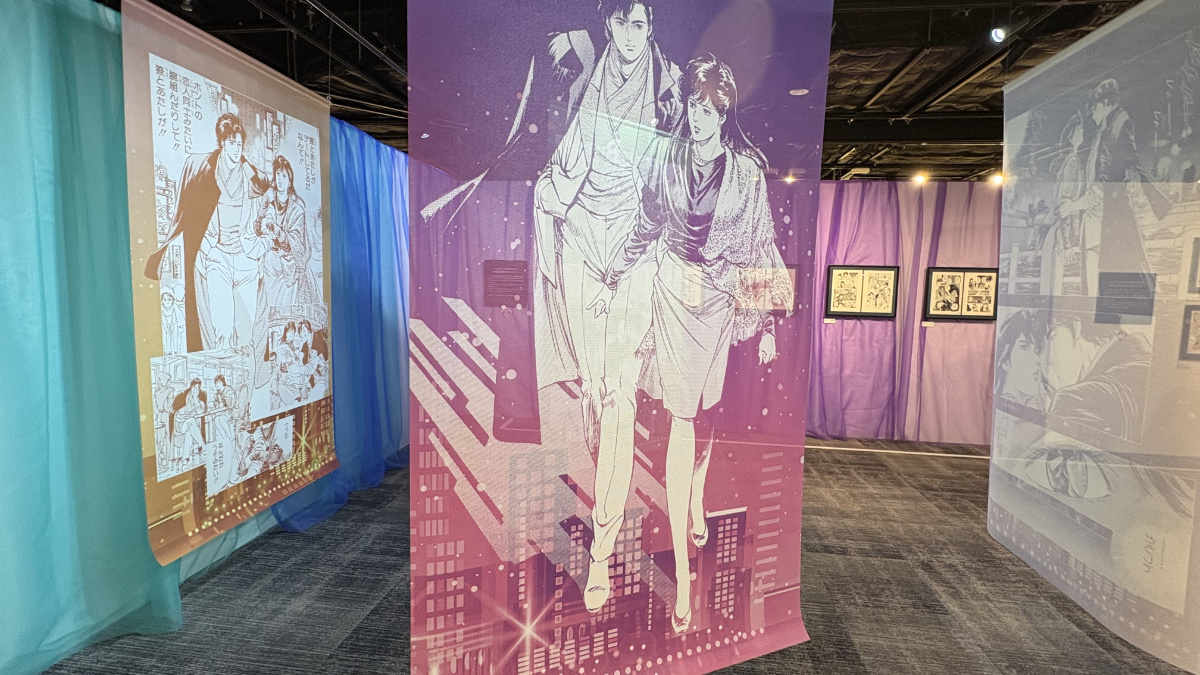
Original artwork can also be seen beyond the curtains, and the changing relationship between the two becomes clearer as visitors progress.
Their relationship does not change all at once in a single scene. Moving through the exhibition in order lets visitors follow how Ryo’s uncertainty, Kaori’s awkward feelings, and their need for each other gradually accumulate.
Hirako’s Favorite Line: Grief for His Best Friend Makimura and a Vow of Revenge
Of the many famous lines, Hirako chose the words Ryo speaks while holding his best friend Makimura after losing him.
On the surface, the line seems to assume that his best friend Makimura is also going to hell, which makes it sound slightly worthy of a playful retort.
Its real meaning, however, is Ryo’s vow to defeat Makimura’s killers and send them there at once. Hirako explained that a single line contains the violence of the battle to come, Ryo’s confidence in his abilities, and his deep affection for Makimura.
Even immediately after a comedic exchange, the story can shift at once into this rugged hard-boiled mode. That contrast is quintessentially CITY HUNTER.
As a Fan of the Manga, Hirako Cannot Step Between the Two Behind the Glass
The special installation Hirako discussed most passionately recreates Ryo and Kaori through the glass.
Visitors can step into the scene for a photo, but as someone who read the manga to the end, Hirako wants to preserve the private world of the two characters. He said he feels the meaning of the scene would break the moment he entered the picture.
Even when the host suggested standing at the edge, he immediately replied, “Absolutely not. It would ruin everything.”
His strong reaction conveyed just how important this scene is to fans.
This is the famous scene through glass that Hirako said he could not enter between.
Those New to the Manga Can Begin with the Exhibition
When the host said they did not know the series very well, Hirako replied, “You have the joy of getting to discover it now.”
Visitors can remember the original pages they saw, read the manga afterward, and match them to the scenes: “So that was where that original page appeared.” It is enjoyable even in the reverse order from seeing the artwork after already knowing the complete story.
Hirako himself said he would like to erase all his memories and read the series again from the beginning.
The venue carries not only the history of the manga but also an atmosphere tied to dreams of city life and 1980s city pop. Even the name CITY HUNTER combines two words that sounded cool: “City” and “Hunter.” Add “Get” and “Wild,” and the young Hirako of that era was overwhelmed by its urban cool.
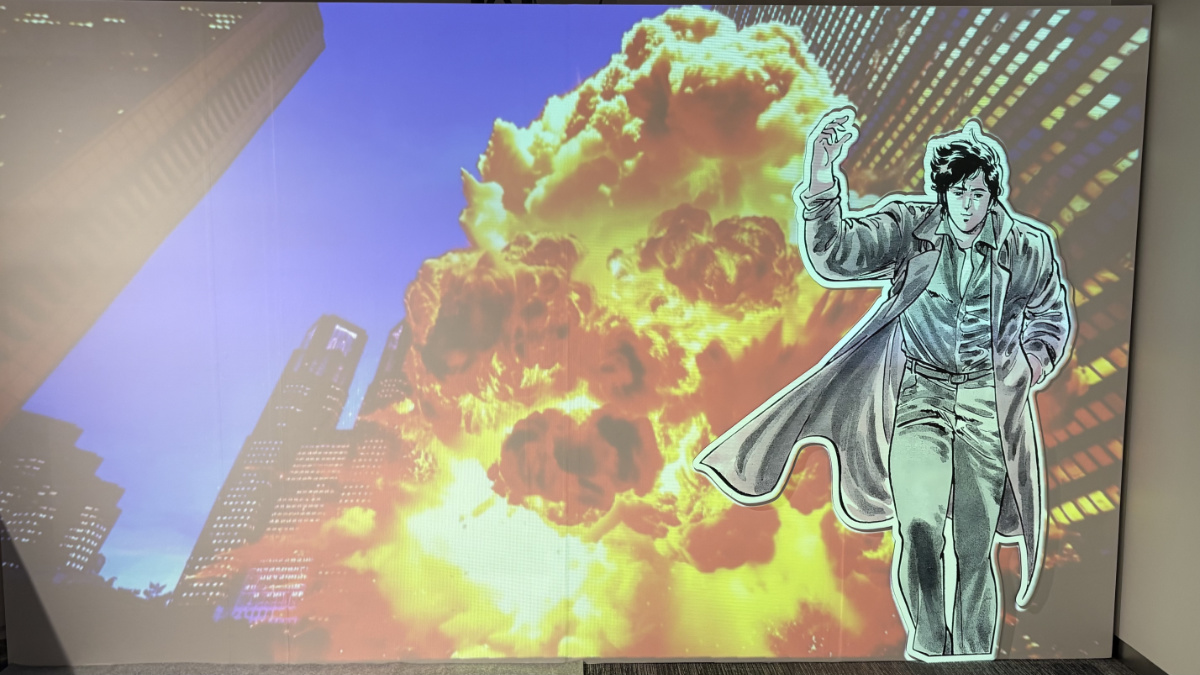
In the special video near the end of the exhibition, famous scenes and music come together to revive memories of the series all at once.
A Scale Worthy of the “Grand” in the Original Art Exhibition’s Name
At the end of the talk, Hirako emphasized that the exhibition’s scale and content truly deserve the “grand” in its Japanese title.
There is so much to see that he joked devoted manga fans who begin studying every detail might not be able to leave for eight hours.
At the same time, people who know the name but have never seen the series can also enjoy it. The exhibition can lead them back to the manga and give them the pleasure of finding the scenes they encountered at the venue.

Yuki Hirako’s talk event and footage of the exhibition can be viewed in the video below.
↑ Tap the image twice to play the video
The video above includes Yuki Hirako’s talk and footage of the Osaka exhibition. To get a sense of the atmosphere before visiting, watch in an environment where you can play the audio.
How Long Does the CITY HUNTER Original Art Exhibition Take?
No official estimated visit time has been announced.
There are more than 400 original works, seven chapters, multiple photo spots, and a special video, while the audio guide contains 22 tracks totaling about 23 minutes. Given the volume, the time needed varies greatly between a quick look at the main exhibits and a close reading of the original pages.
Editorial Estimate for Visit Duration
- Main exhibits and photo spots: 60–90 minutes
- Captions and original artwork in detail: 90–120 minutes
- Manga fans using the audio guide and taking photos: 2–3 hours or more
This is an editorial estimate based on the volume of exhibits, not an official figure. Actual time varies with crowd levels and viewing pace.
Visitors planning to take many photos or alternate taking pictures with friends or family should allow even more time.
Last admission is at 5:30 p.m., but the venue closes at 6:00 p.m. Entering at 5:30 p.m. will not leave enough time for a careful visit. Those who want to look closely should aim to enter no later than sometime in the 4:00 p.m. hour.
Audio Guide Narration by Akira Kamiya, Kazue Ikura, and Tessho Genda
The audio guide is narrated by Akira Kamiya, Kazue Ikura, and Tessho Genda.
It contains 22 tracks totaling about 23 minutes. Rental costs US$6.25 per person for one device, and payment is cash only.
Those with a strong attachment to the manga or anime may find that following the exhibition with the familiar voices deepens the experience. Because cashless payment is not accepted, bring cash if you plan to rent the audio guide.
Points That Can Be Confusing About Tickets and Admission Times
Some time slots at the Osaka venue require date-and-time-specific tickets.
Admission from 11:00 a.m. to noon uses date-and-time-specific tickets. Flexible tickets valid during the exhibition period are available for admission from noon to 5:30 p.m.
- Adults: US$15.63 at the door
- Elementary and junior high school students: US$6.88 at the door
- Preschool children: Free when accompanied by a guardian
- No refunds or changes to the date and time are permitted after purchase
- Each visitor is scheduled to receive one sticker selected at random from seven designs. Supplies of the admission gift are limited.
Visitors with 11:00 a.m. admission should note that Namba Parks itself opens at 11:00 a.m. Official guidance asks holders of 11:00 a.m. tickets to arrive in front of the venue by 11:10 a.m.
For all other date-and-time-specific tickets, plan to gather 10 minutes before the admission time. Avoid arriving too early and waiting near the venue, as this may inconvenience nearby stores.
The Exhibition and Merchandise Areas Are Separate: See the Exhibition First
The merchandise area is in Parks Hall on the same seventh floor.
A ticket used for admission that day is required, and visitors proceed to the merchandise area after viewing the exhibition. Re-entry is not allowed after leaving either the exhibition or merchandise area.
Those planning a long visit should use the restroom before entering. If you plan to buy merchandise, allow time for shopping in addition to viewing the exhibition.
Access to Namba Parks Museum
The venue is on the seventh floor of Namba Parks at 2-10-70 Nambanaka, Naniwa Ward, Osaka.
It is directly connected to Nankai Railway’s Namba Station. It is about a seven-minute walk from Namba Station on the Osaka Metro Midosuji Line, and about a 10-minute walk from Namba Station on the Sennichimae Line or Osaka-Namba Station on the Hanshin and Kintetsu lines.
When arriving by subway, travel time varies by exit even though several stations share the name “Namba.” Follow signs for Namba Parks and Nankai Namba Station.
The seventh floor also has the limited-time collaboration café “#702 CAFE&DINER.” Advance reservations are given priority, so check availability first if you want to visit the café on the same day.
Who Is This Exhibition Best For?
The visitors most likely to be satisfied are fans who want to revisit famous scenes from the manga.
It also suits people who love the anime ending song “Get Wild,” discovered the series through Netflix’s live-action film, or want to see Tsukasa Hojo’s artwork up close. Because the story unfolds across seven chapters, even those who have not read the manga can follow it without feeling left behind.
Friends and couples can also enjoy taking photos at the underground shooting range, the scene through glass, and Café Cat’s Eye.
Families with small children may find that carefully viewing all 400-plus works takes a long time. A practical approach is to prioritize the photo spots and displays featuring favorite characters rather than trying to read every original page.
Buy on ASOVIEW: CITY HUNTER Original Art Exhibition
Admission Ticket
CITY HUNTER Original Art Exhibition Osaka FAQ
Can I enter the CITY HUNTER Original Art Exhibition without a reservation?
It depends on the time slot. Admission from 11:00 a.m. to noon is date-and-time specific. Same-day tickets are sold when space is available, but sales stop once capacity is reached, so advance purchase is recommended if you know the day you plan to visit.
Can I take photos inside the venue?
Photos may be taken with smartphones, mobile phones, and tablets, but some areas prohibit photography. Close-ups of artwork alone, video, audio recording, flash, digital cameras, selfie sticks, and tripods are not permitted. Follow signs at the venue and staff instructions.
Can I enjoy the exhibition without knowing CITY HUNTER well?
Yes. The seven chapters trace Ryo and Kaori’s relationship, and the photo spots and special video make the world accessible even to people unfamiliar with the story. You can also read the manga afterward and look for the scenes you saw at the exhibition.
How much time should I allow?
The editorial estimate is 60–90 minutes for the main exhibits and 90–120 minutes to study the original pages and captions. Manga fans who use the audio guide and take photos should allow two to three hours or more for an unhurried visit.
Can I pay for the audio guide without cash?
The audio guide costs US$6.25 and is cash only. Bring cash before entering the venue if you plan to rent one.
An Osaka Venue Packed with the Value of Seeing Original CITY HUNTER Artwork in Person
The Osaka venue of the CITY HUNTER Original Art Exhibition is memorable not only for its more than 400 original works but also for the immersive staging that draws visitors into the story.
Ryo and Kaori’s meeting, the loss of Makimura, time spent with friends and clients, and famous scenes in which the distance between the two gradually changes: following them in order reveals again that CITY HUNTER is not only hard-boiled action and comedy but also a story about trust between people.
As Yuki Hirako said, longtime fans can study the details while newcomers can enter the story through the exhibition.
Do not rush through only to take photos. Look closely at the lines, corrections, color, and lettering left on the manuscripts. A panel you know from the manga may become, before your eyes, an original work of art.
Exchange rate used: US$1 = ¥160.

Make the latest USJ and Kansai event updates
easier to find on Google.






![Osaka Temperatures by Month | What to Wear at USJ for Morning-to-Night Temperature Swings [Women & Men]](https://happyell.co.jp/world/wp-content/uploads/2026/08/usj-osaka-temperature-clothingtitle-600x338.jpg)