
What you’ll learn in this article
- Monthly temperatures and clothing guidelines for Osaka and USJ from January through December
- Women’s and men’s outfit ideas for spring/fall temperature swings and extreme summer heat
- How to choose clothing and layers for staying comfortable from before park opening through the evening
What you’ll learn in this article
- Monthly temperatures in Osaka and at USJ based on observed data from 2023–2026
- Women’s and men’s outfit ideas for spring/fall temperature swings and recent extreme summer heat
- How to choose clothing and layers for staying comfortable from before park opening through the evening
What you wear for a full day of sightseeing in Osaka may not be the same as what you need at USJ from before opening until night.
Summer heat has been especially severe in recent years. In Osaka from 2023–2026, the monthly average of daily high temperatures was about 34.0°C in July and about 35.1°C in August.
Osaka also recorded a high of 38.3°C on July 23, 2026, and 38.1°C on August 2, 2025.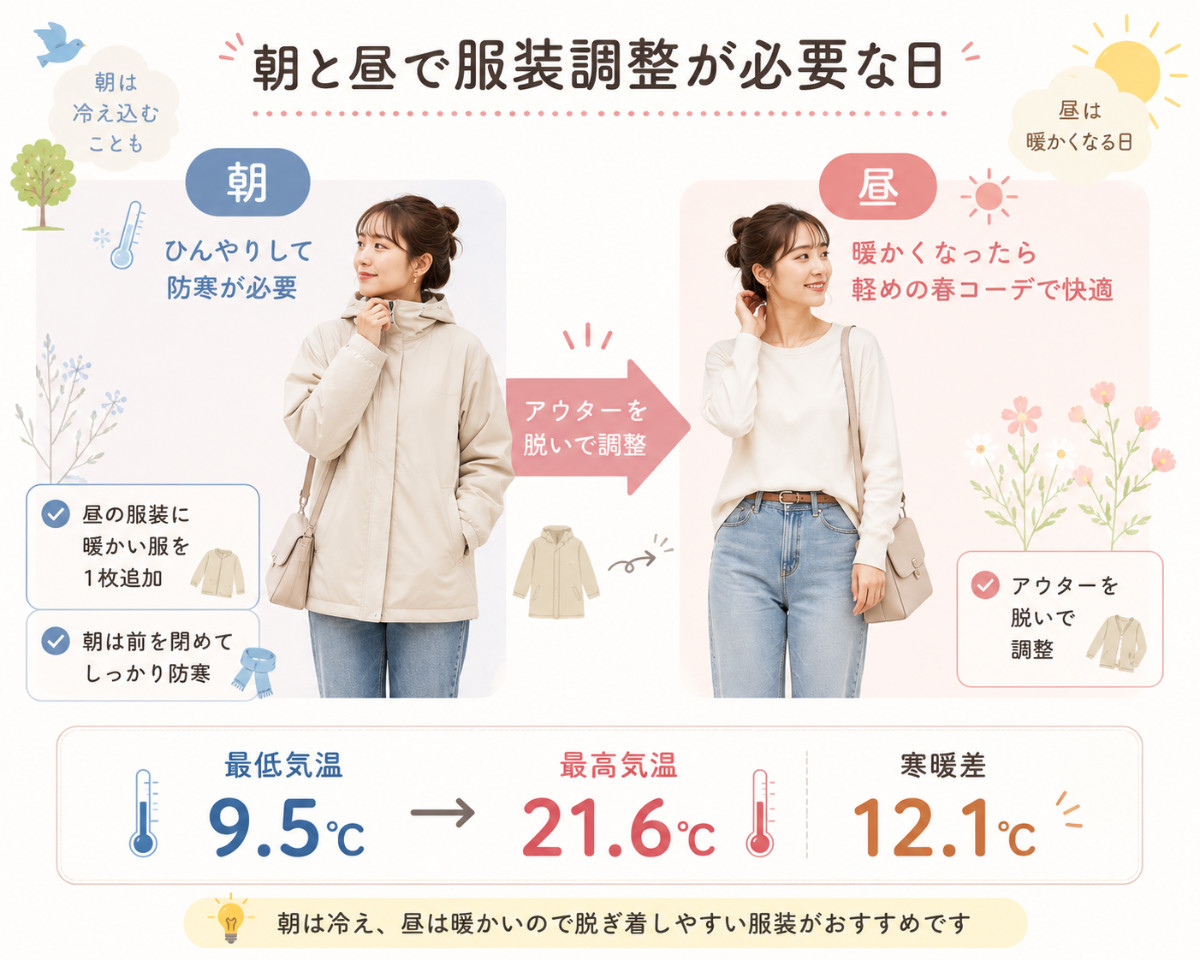 In spring and fall, meanwhile, some days have a large temperature difference between morning and midday. On March 28, 2026, the temperature rose from a low of 9.5°C to a high of 21.6°C, a daily swing of 12.1°C.
The key to choosing what to wear at USJ is to look at the forecast high, forecast low, the difference between them, and the hours you’ll be in the park.
Monthly averages, actual highest temperatures, and daily temperature swings are different figures
When looking at temperatures, it is important to distinguish these three figures.
- Monthly average of daily highs:The average of each day’s high temperature during that month
- Highest temperature within the month:The highest temperature actually observed during that month
- Daily temperature swing:The difference between the high and low temperature on the same day
For example, in July 2026 the monthly average of daily highs was 33.5°C, but there was a day when the temperature actually reached 38.3°C.
When deciding what to wear, don’t stop at thinking “July averages around 34°C.” Check whether the forecast high for your visit is 35°C or closer to 38°C.
How warm or cold is Osaka each month?
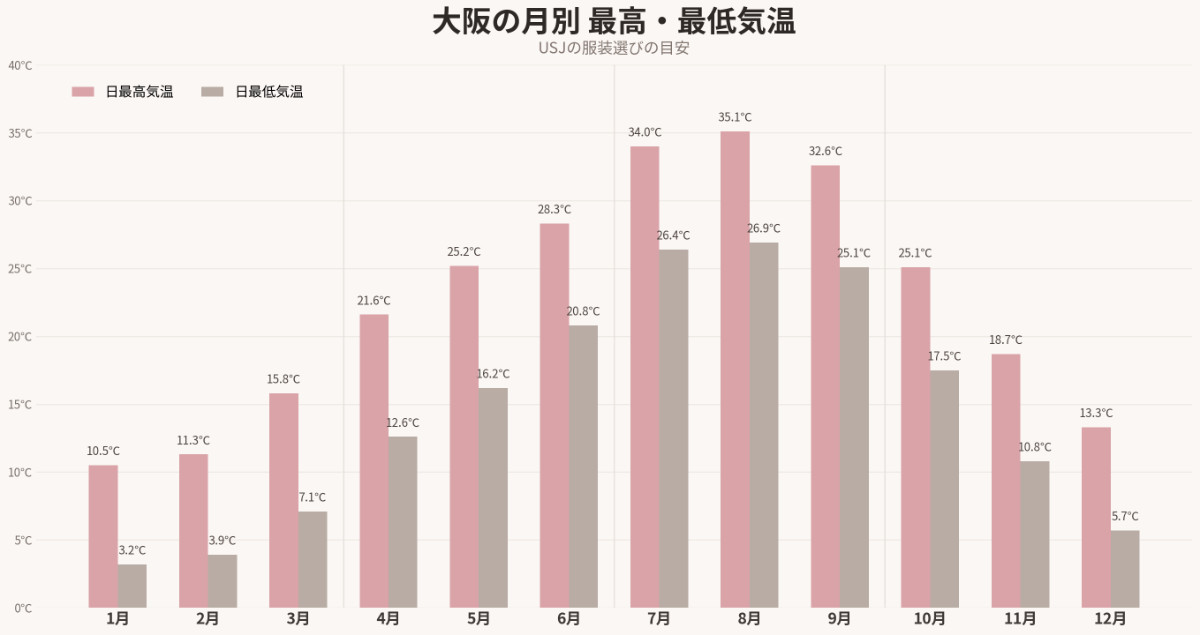 Rather than using older climate normals, the monthly temperatures here were calculated from recent 2023–2026 data at the Japan Meteorological Agency’s Osaka observation station.
January–August use the average for 2023, 2024, 2025, and 2026; September–December use the average for 2023, 2024, and 2025.
Because August 2026 includes only data available partway through the month, treat the August figure as a reference value as of this point.
| Month | Recent temperatures Average / daily high / daily low |
|---|---|
| January | 6.7°C / 10.5°C / 3.2°C |
| February | 7.3°C / 11.3°C / 3.9°C |
| March | 11.1°C / 15.8°C / 7.1°C |
| April | 16.7°C / 21.6°C / 12.6°C |
| May | 20.3°C / 25.2°C / 16.2°C |
| June | 24.1°C / 28.3°C / 20.8°C |
| July | 29.5°C / 34.0°C / 26.4°C |
| August | 30.2°C / 35.1°C / 26.9°C |
| September | 28.2°C / 32.6°C / 25.1°C |
| October | 20.8°C / 25.1°C / 17.5°C |
| November | 14.5°C / 18.7°C / 10.8°C |
| December | 9.2°C / 13.3°C / 5.7°C |
* January–August figures were calculated from Japan Meteorological Agency monthly values for “Osaka” for 2023–2026; September–December use 2023–2025. August 2026 is a reference value because the month was still in progress.
The table shows that in recent years Osaka’s average daily high has reached about 34°C in July and about 35°C in August.
September’s average daily high over the latest three years is also 32.6°C, so it is too early to assume “September means fall clothes.”
From March–May and October–November, check the low as well as the high. Even within the same month, the clothing you need in the morning can differ greatly from what you need at midday.
Recent trends visible in 2023–2026 temperatures
Looking at recent observed data, the two things to keep especially in mind when dressing for Osaka and USJ are hotter summers and spring/fall temperature swings.
- July 23, 2026: high 38.3°C, low 29.2°C
- August 2, 2025: high 38.1°C, low 27.8°C
- March 28, 2026: high 21.6°C, low 9.5°C, swing 12.1°C
- November 16, 2025: high 20.9°C, low 9.5°C, swing 11.4°C
On July 23, 2026, even the low was 29.2°C, so it did not become truly cool even in the early morning or at night.
For a recent summer visit to USJ, don’t just ask whether it will be above 30°C. Check whether it will exceed 35°C or climb to around 38°C and use that to decide your clothing and heat precautions.
Spring and fall are the opposite: even with a high around 20°C, the low can drop to around 10°C.
If you arrive at USJ early in the morning and stay until night, don’t choose your outfit based only on daytime conditions.
Daily temperature swings tend to be larger in March and November
Using March 2026 daily data, the average difference between each day’s high and low was about 8.8°C across 31 days.
There were 11 days with a swing of 10°C or more, with the largest at 12.1°C on March 28.
On March 28, the temperature rose from a morning low of 9.5°C to a daytime high of 21.6°C.
If you arrive at USJ early, you may want a light outer layer in the morning but feel like taking it off and spending midday in just a long-sleeve top.
In November 2025, the average daily temperature swing over 30 days was about 7.8°C.
On November 16 and 23, the difference was 11.4°C on both days: the 16th ranged from 9.5°C to 20.9°C, and the 23rd from 6.8°C to 18.2°C.
For spring and fall visits, check both the forecast high and low.
As a practical Happyell guideline, if the high-low difference is 7°C or more, bring a layer you can take on and off; if it is 10°C or more, pay particular attention to an outer layer for morning and evening.
January temperatures and clothing for Osaka and USJ
January calls for winter protection all day
From 2023–2026, January averaged about 6.7°C, with an average daily high of about 10.5°C and an average daily low of about 3.2°C.
Actual lows fell to -2.0°C in January 2023, -0.4°C in January 2025, and -0.3°C in January 2026.
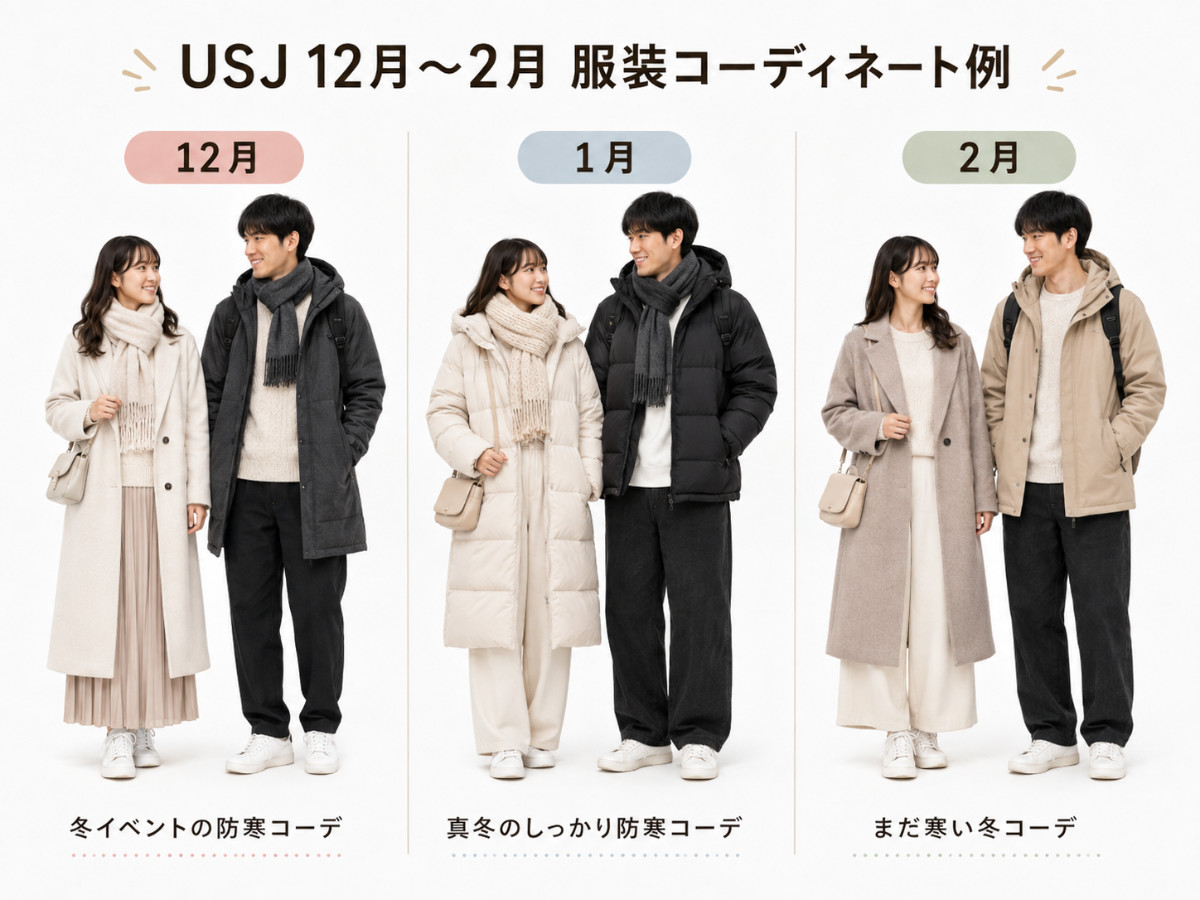
If you will line up before opening or stay through the evening, dress for winter conditions.Women:A down or insulated coat, knitwear, thermal base layer, and lined pants are a solid baseline. If you wear a skirt, keep your legs warm with thick tights or similar items.Men:Layer a knit or sweatshirt and a thermal base layer under a down jacket or wind-resistant coat.
February temperatures and clothing for Osaka and USJ
Keep winter clothing as the base in February, even when warmer days appear
From 2023–2026, February averaged about 7.3°C, with an average daily high of about 11.3°C and an average daily low of about 3.9°C.
There was considerable year-to-year variation: the monthly average of daily highs was 9.2°C in February 2025 but 12.7°C in 2026. One day in February 2026 reached 21.4°C.
Even if midday feels springlike, mornings can still fall close to freezing.Women:Wear a winter coat over layers you can remove, such as a knit and a lightweight inner layer.Men:Use a wind-resistant outer layer with a sweatshirt or knit and a long-sleeve base layer as your baseline.
March temperatures and clothing for Osaka and USJ
In March, mornings can feel like winter and afternoons like spring
From 2023–2026, March averaged about 11.1°C, with an average daily high of about 15.8°C and average daily low of about 7.1°C.
There was also year-to-year variation: the monthly average of daily highs was 18.3°C in March 2023 but 13.5°C in 2024.
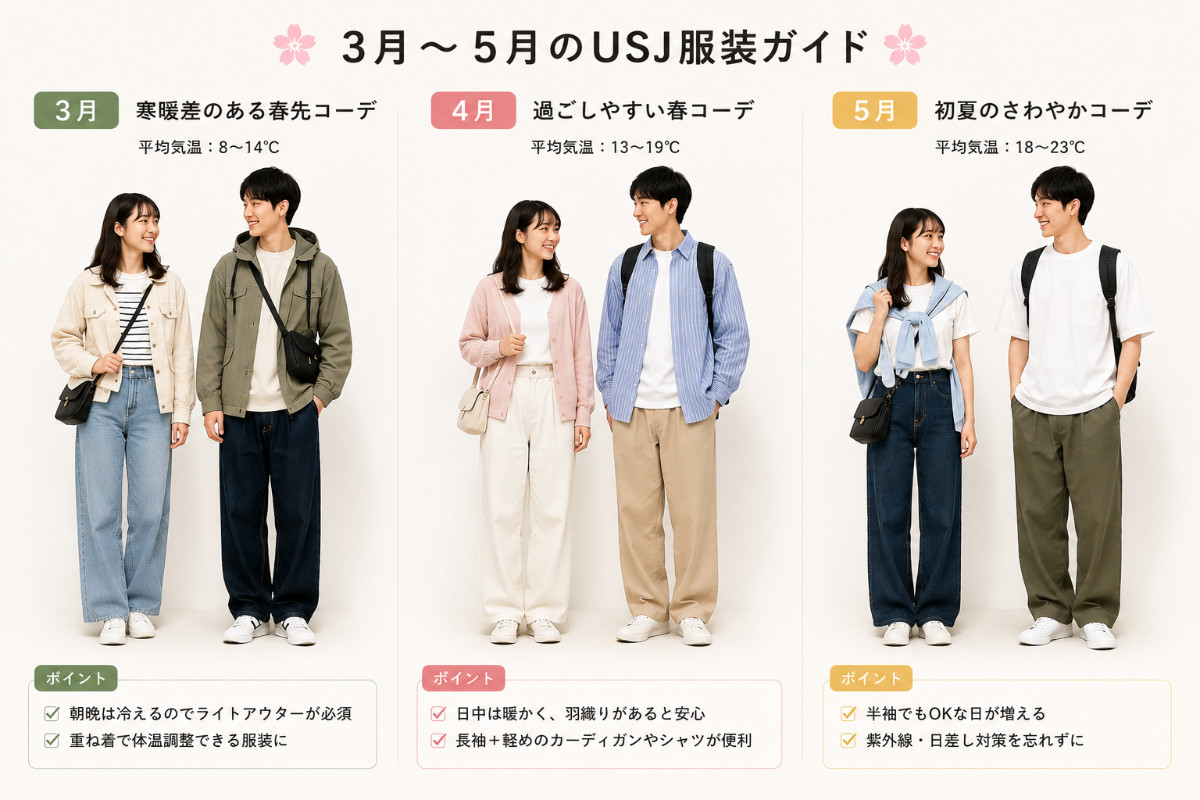
In March 2026, the average daily temperature swing was about 8.8°C, and on 11 of the 31 days the difference between the high and low was 10°C or more.Women:Pair a lightweight coat or mountain parka with a knit, shirt, or cardigan.Men:A light outer layer, long-sleeve T-shirt or shirt, and lightweight sweatshirt are practical choices.
April temperatures and clothing for Osaka and USJ
Keep daytime layers light in April while still bringing something for mornings and evenings
From 2023–2026, April averaged about 16.7°C, with an average daily high of about 21.6°C and average daily low of about 12.6°C.
Over the latest four years, the monthly average of daily highs ranged from 20.9°C to 22.6°C.
More days are comfortable with just a long-sleeve top during the day, but a light outer layer is useful for early-morning entry lines and evenings.Women:Try a long-sleeve top or blouse with a cardigan, lightweight jacket, or trench coat.Men:A shirt or long-sleeve T-shirt layered with a light blouson or cardigan makes it easy to adjust.
May temperatures and clothing for Osaka and USJ
Short sleeves become more common in May, but one extra layer is handy for mornings and evenings
From 2023–2026, May averaged about 20.3°C, with an average daily high of about 25.2°C and average daily low of about 16.2°C.
The month’s highest temperature reached 30.5°C in May 2025 and 31.5°C in May 2026.
Recent Mays can bring not only days above 25°C but also days above 30°C, so short sleeves are increasingly appropriate on sunny afternoons.
On the other hand, the month’s low reached 10.8°C in May 2025 and 11.3°C in 2026.Women:Pair a short-sleeve or lightweight long-sleeve top with a cardigan, sheer shirt, or light jacket.Men:Build around a short-sleeve T-shirt or lightweight shirt, and bring a long-sleeve shirt or lightweight hoodie.
June temperatures and clothing for Osaka and USJ
Prioritize humidity and rain in June
From 2023–2026, June averaged about 24.1°C, with an average daily high of about 28.3°C and average daily low of about 20.8°C.
In June 2025, the monthly average of daily highs rose to 29.6°C, and the month’s high reached 34.4°C.
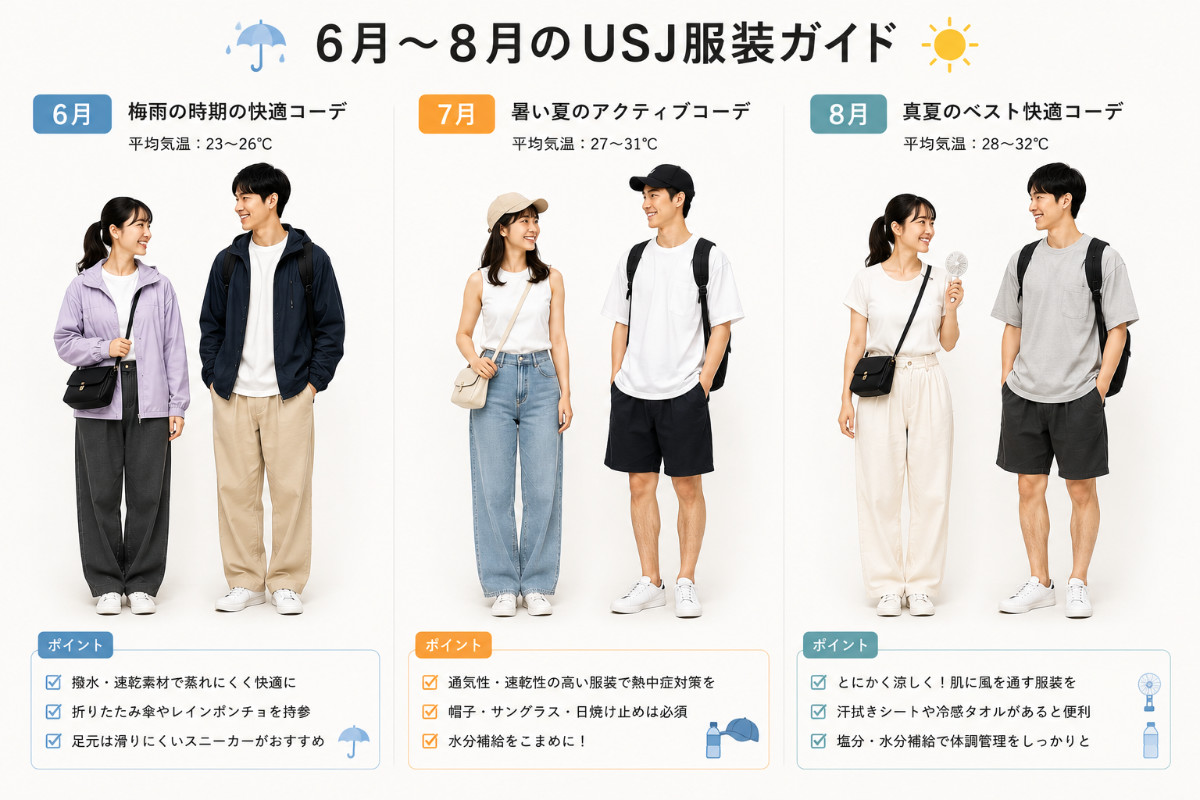
Don’t assume the rainy season means it will not be very hot; some days can feel close to midsummer.Women:Quick-drying short-sleeve tops, lightweight dresses, and breathable pants are good choices.Men:Moisture-wicking T-shirts, lightweight shirts, and quick-drying pants are practical.
July temperatures and clothing for Osaka and USJ
Plan for heat around 35°C in July
From 2023–2026, July averaged about 29.5°C, with an average daily high of about 34.0°C and average daily low of about 26.4°C.
By year, the monthly average of daily highs was 33.7°C in 2023, 33.5°C in 2024, 35.3°C in 2025, and 33.5°C in 2026.
The month’s high reached 38.7°C in July 2025, while July 23, 2026 reached 38.3°C.
In recent Julys, don’t simply plan for “above 30°C”; assume around 35°C, with the hottest days in the 38°C range.Women:Moisture-wicking short sleeves or sleeveless tops, airy dresses, and lightweight pants work well.Men:Choose moisture-wicking T-shirts, breathable shirts, and lightweight pants or shorts.
Rather than waiting until you feel unwell, take breaks early by mixing in indoor attractions and restaurants.
August temperatures and clothing for Osaka and USJ
Use above 35°C as the baseline for August preparation
Combining confirmed data from 2023–2025 with data available partway through August 2026, the average temperature is about 30.2°C, the average daily high about 35.1°C, and the average daily low about 26.9°C.
The monthly average of daily highs exceeded 35°C for three straight years: 35.2°C in August 2023, 35.4°C in 2024, and 35.4°C in 2025.
The month’s highest temperatures were also 38.6°C in 2023, 38.3°C in 2024, and 38.1°C in 2025.
In other words, in recent Augusts, 35°C is not an unusual level of heat—the monthly average of daily highs itself is around 35°C.
Nighttime lows are also often above 25°C, so prioritize heat preparation over concern about cool mornings and evenings.Women:Quick-drying tops, loose-fitting dresses, and lightweight pants are recommended.Men:Build around quick-drying T-shirts with lightweight shorts or light long pants.
September temperatures and clothing for Osaka and USJ
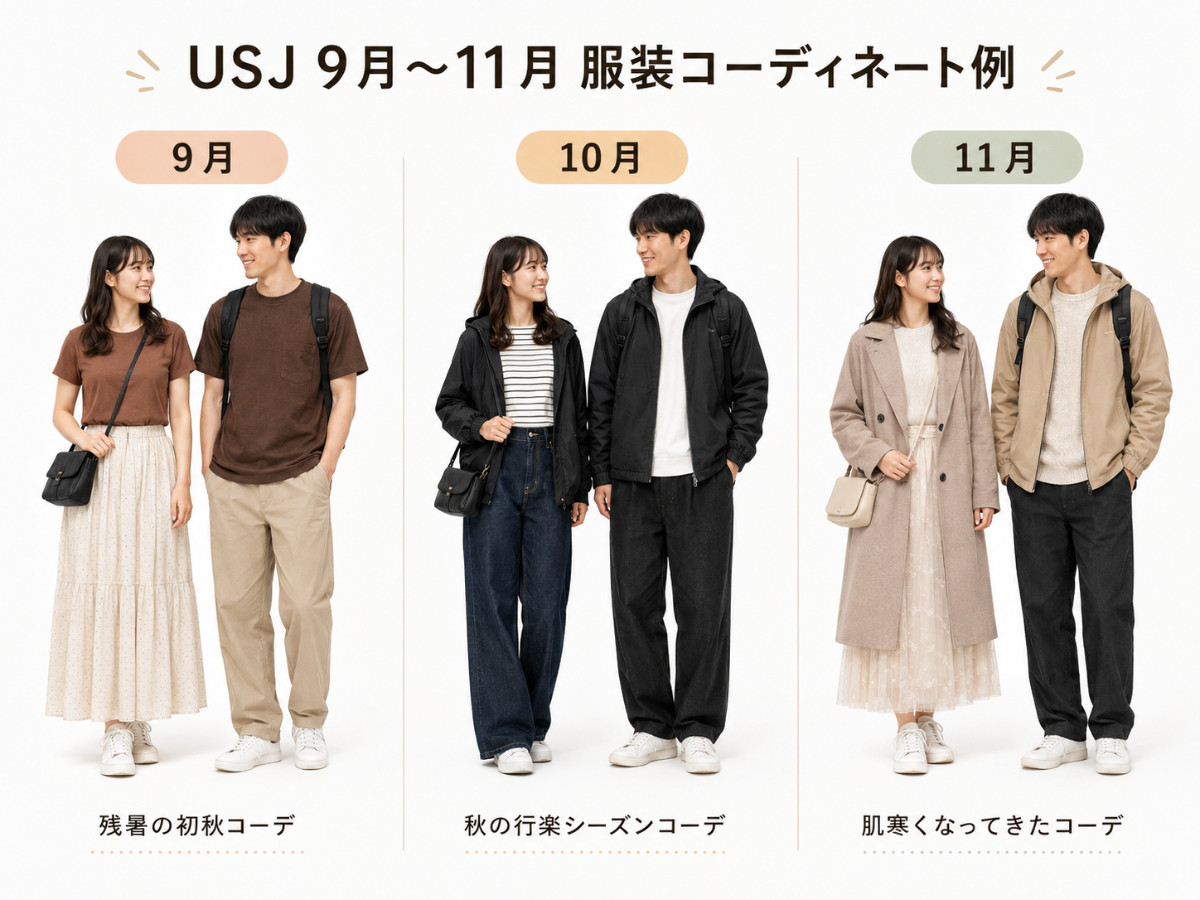
Treat September as lingering summer heat, not “fall”
From 2023–2025, September averaged about 28.2°C, with an average daily high of about 32.6°C and average daily low of about 25.1°C.
By year, the monthly average of daily highs was 32.5°C in 2023, 33.0°C in 2024, and 32.3°C in 2025.
Looking at the month as a whole, recent Septembers are still close to midsummer temperatures.
September 2025 reached a high of 36.5°C, so some days still require heat precautions even after the Halloween season begins.Women:Center your outfit on short-sleeve tops or a lightweight dress, adding a thin shirt or cardigan as needed.Men:Use short-sleeve T-shirts or lightweight shirts with light pants as your baseline.
October temperatures and clothing for Osaka and USJ
What to wear can change greatly from early to late October
From 2023–2025, October averaged about 20.8°C, with an average daily high of about 25.1°C and average daily low of about 17.5°C.
In October 2025, however, the month’s high reached 31.8°C while the low fell to 10.3°C, showing a wide range within the same month.
Even on days when short sleeves are comfortable at midday, it can suddenly feel cool if you stay in the park through a Halloween evening.Women:Early in the month, try short sleeves plus a layer. As temperatures drop, shift to long-sleeve tops or a lightweight knit with a jacket.Men:Combine a short- or long-sleeve T-shirt with a light blouson, cardigan, or thin hoodie.
November temperatures and clothing for Osaka and USJ
November can feel like fall by day and closer to winter in the morning and evening
From 2023–2025, November averaged about 14.5°C, with an average daily high of about 18.7°C and average daily low of about 10.8°C.
In November 2025 daily data, the average daily temperature swing was about 7.8°C, and November 16 and 23 each had an 11.4°C difference.
On the 16th, temperatures rose from 9.5°C to 20.9°C; on the 23rd, from 6.8°C to 18.2°C.Women:Wear a knit or sweatshirt with a jacket, trench coat, or lightly insulated outer layer.Men:Layer a blouson or coat over a knit, sweatshirt, or long-sleeve shirt.
December temperatures and clothing for Osaka and USJ
Make winter outerwear your baseline in December
From 2023–2025, December averaged about 9.2°C, with an average daily high of about 13.3°C and average daily low of about 5.7°C.
In December 2025, however, the month’s high reached 20.8°C while the low fell to 1.1°C.
December can have warm days, but if you will spend the full day at USJ from morning through night, use winter outerwear as your baseline.Women:A wool coat or down jacket, knitwear, long-sleeve base layer, and pants or thick tights.Men:Layer a knit or sweatshirt and long-sleeve base layer under a coat or down jacket.
Seasons when early mornings and nights feel especially cold at USJ
The period when you should pay particular attention to cold mornings and evenings is November through March.
Meanwhile, March–May and October–November are seasons when it is useful to be able to change layers during the day.
Actual examples show a maximum daily swing of 12.1°C in March 2026 and 11.4°C in November 2025.
Even though September is a season for nighttime events, the latest three-year average of daily highs exceeds 32°C.
Don’t assume “it’s fall, so nights will be cold.” Check the hourly forecast for your visit.
Layering for a day from morning to night
- Base layer: something that absorbs sweat and dries quickly
- Middle layer: shirt, cardigan, or lightweight knit
- Outer layer: wind- and cold-resistant outerwear suited to the season
Rather than relying on one heavy layer, being able to add or remove pieces as temperatures change and as you move indoors and outdoors makes it easier to enjoy both attractions and meals.
Choosing clothes during seasons with large temperature swings
From March–May, plan to remove a layer at midday
In spring, you may become warm if you keep wearing your morning outfit while walking around during the day.
Choose a top that is comfortable even after you remove your outer layer, and pick outerwear that folds down easily.
For women, cardigans, sheer shirts, and lightweight trench coats are easy to adjust. For men, long-sleeve shirts, light blousons, and thin hoodies work well.
From October–November, plan to put a layer on at night
In fall, you may not need an outer layer when you enter, but you are more likely to wear one from late afternoon onward.
If the forecast low is in the single digits Celsius, such as in late November, step up from a light outer layer to a coat or insulated jacket.
Temperature-based clothing guide for both women and men
If you’re unsure based on the month alone, use the forecast high for your visit as the starting point and also check the difference from the low.
With a difference of 7°C or more, bring a layer you can take on and off. At 10°C or more, pay extra attention to an outer layer for mornings and evenings, and adjust one level for wind or rain.
High of 35°C or above
Prioritize quick-drying fabrics and breathability. Avoid direct sun with a hat or parasol, and take breaks early indoors or at restaurants.
High of 30–34°C
Focus on short sleeves or sleeveless tops, quick-drying fabrics, and breathable bottoms. Prepare for sun and sweat as well.
High of 25–29°C
Use short sleeves as the base. Add a lightweight layer if mornings or evenings will be below 20°C or rain is forecast.
High of 20–24°C
A single long-sleeve layer, or short sleeves plus a lightweight outer layer. This is a range where layering is especially useful at USJ in spring and fall.
High of 15–19°C
Wear a long-sleeve top with a jacket or blouson. If the low will be below 10°C, add a lightweight knit or thermal base layer.
High of 10–14°C
Wear a coat over a knit or sweatshirt. If you will stay through morning and night, also prepare something to keep your neck and hands warm.
High below 10°C
Use a down jacket or highly wind-resistant winter coat, thermal base layers, and cold-weather accessories as your baseline.
Three temperatures to check the day before your USJ visit
When making your final clothing decision, check the hourly forecast for your visit rather than relying on monthly averages.
In summer, check whether the high will exceed 35°C or rise to around 38°C. In spring and fall, check whether the difference between the high and low will be 10°C or more.
- Temperature when you arrive:Decides what to wear if you will wait before opening
- Daytime high:Decides your top and heat/cold precautions
- Temperature at your planned departure time:Decides your evening layer and cold-weather accessories
If the forecast high and low differ by 7°C or more, bring a layer you can take on and off. If the difference is 10°C or more, pay particular attention to an outer layer for mornings and evenings.USJ hourly weather forecast
Choose shoes and a bag for a full day of fun
At USJ, you spend time not only walking but also standing while waiting.
Choose sneakers or other shoes you already know are comfortable for long periods, rather than focusing only on appearance. That will make it easier to keep moving into the evening.
For a bag that needs to hold spring/fall layers, a summer change of clothes, or winter accessories, a hands-free style is convenient.
Osaka and USJ monthly temperatures and clothing: summary
Osaka temperatures since 2023 show recent patterns that older climate normals alone may not make obvious.
Average daily highs are about 34°C in July, 35°C in August, and 33°C even in September, so for July–September, dressing for hotter conditions than the traditional seasonal image better matches recent reality.From March–May and October–November, meanwhile, the difference between the same day’s high and low can exceed 10°C.
Use wind-resistant outerwear in winter, light layering in spring and fall, and quick-drying, breathable clothing in summer.
After checking the monthly data, be sure to look at three temperatures for your visit: “arrival,” “daytime high,” and “departure.”
Frequently asked questions about Osaka and USJ temperatures and clothing
Can I choose what to wear at USJ based only on the monthly average temperature?
It is better not to rely on the monthly average alone.
July 2026 included a day with a high of 38.3°C, while March 2026 included a day with a 12.1°C temperature swing.
Check the forecast high and low and the hourly forecast for the day you visit.
How hot have Osaka summers been recently?
The monthly average of daily highs in July 2023–2026 was about 34.0°C. Combining August 2023–2025 with data available partway through August 2026 gives about 35.1°C.
In particular, the monthly average of daily highs exceeded 35°C in August for three straight years from 2023–2025.
Rather than treating 35°C or above as exceptional, make heat preparation a baseline for a summer USJ visit.
Is September at USJ already time for fall clothes?
In recent years, it is still too early.
From 2023–2025, September’s monthly average of daily highs was about 32.6°C, and one day in 2025 reached 36.5°C.
From early to mid-September, center your outfit on summer clothing. Later in the month, check the forecast and add a lightweight long-sleeve top or layer as needed.
Which months are especially cold at USJ in the morning and at night?
From November through March, pay particular attention to warmth in the early morning and at night.
In March and November, even when midday is warm, it may be cold when you arrive or leave, so removable outerwear is useful.
Do I need a coat at USJ in spring?
In March, use a coat or wind-resistant light outer layer as your baseline.
In April, shift to a lightweight jacket, and in May to a cardigan or shirt. Lighten your layers as the season progresses, adjusting based on the low temperature.
Should I wear short or long sleeves at USJ in October?
The monthly average of daily highs in October over the latest three years is about 25.1°C, but conditions can change greatly from early to late month.
Use short sleeves on days above 25°C and long sleeves around 20°C as a guide. If you will stay until night, bring a lightweight layer.
Do I need an extra layer even at USJ in summer?
Short sleeves are the main choice outdoors, but air conditioning or wet clothing can make you feel cold, so a lightweight UV-blocking hoodie or shirt can be useful.
Choose something light and quick-drying rather than a heavy jacket.
Can women enjoy USJ in a skirt or dress?
Yes, if the length and shape are easy to walk in and unlikely to billow in the wind.
In winter, consider tights; in summer, sweat and sun; and on rainy days, how easily the hem may get wet.
How late in the year can men get by with just a hoodie?
A hoodie works well during the day in April–May and October.
However, early mornings, nights, or days with lows around 10°C can feel too cold with a hoodie alone, so add a lightweight outer layer.
About the temperature data used in this article
This article uses the Japan Meteorological Agency’s “Past Weather Data Search” for the Osaka observation station.
The monthly clothing guidelines were calculated from the following periods to reflect data closer to the current climate rather than older climate normals.
- January–August: 2023, 2024, 2025, 2026
- September–December: 2023, 2024, 2025
- August 2026: reference value because the month was still in progress
For summer extreme heat and spring/fall temperature swings, the article also uses recent daily observed values in addition to monthly averages.
Temperatures vary from year to year, so when you actually visit USJ, always check the latest weather forecast and hourly forecast as well.
Reference: Japan Meteorological Agency “Osaka (Osaka Prefecture) Past Weather Data Search”

Make the latest USJ and Kansai event updates
easier to find on Google.